YouTube Video 7cMg0gRq9Go
## Metadata
- Author: [[YouTube]]
- Full Title: YouTube Video 7cMg0gRq9Go
- Category: #articles
- Document Tags: [[community_tech]] [[data_preservation]] [[local_ai]]
- Summary: YouTube Video 7cMg0gRq9Go
- URL: https://www.youtube.com/watch?v=7cMg0gRq9Go
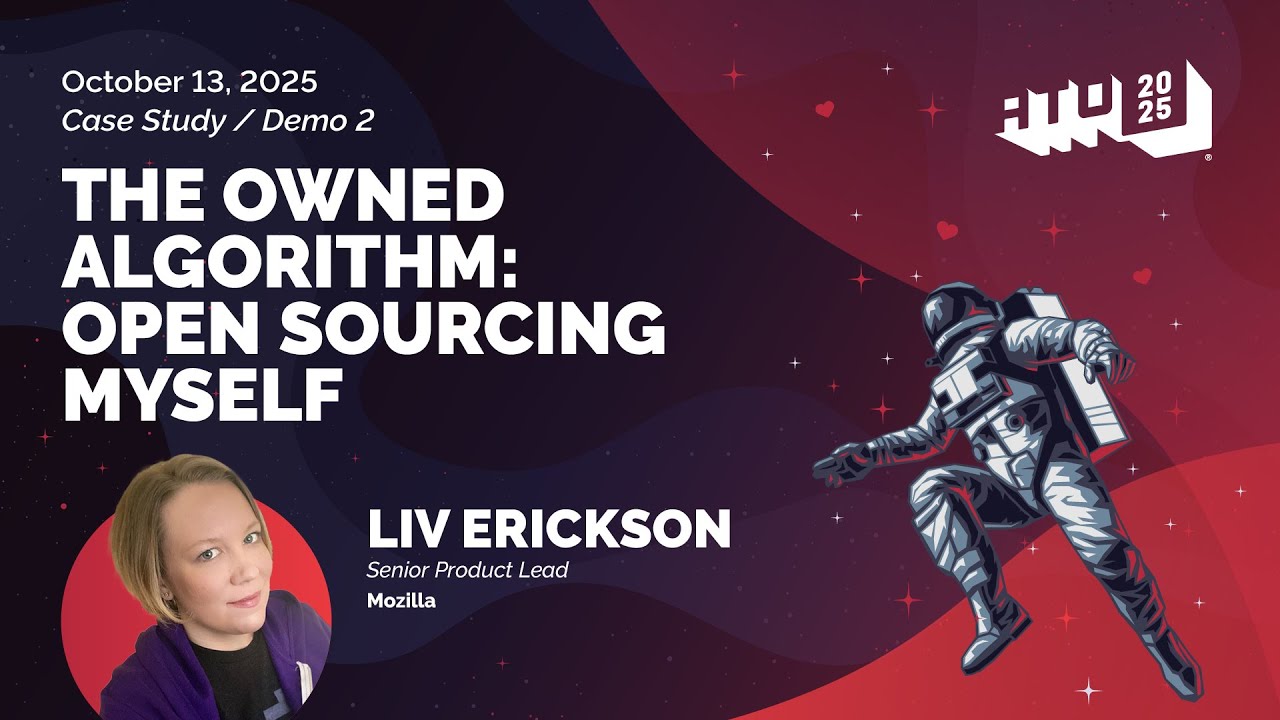
Hey everybody. Uh it is 1:45. I'm going to start because I have crammed a ton of stuff into this presentation and I want to make sure I can get through it all. Um thank you all for coming to this session. I'm really excited to be here giving this talk today because the idea of the owned algorithm is something that I've been exploring in my work uh for about two and a half years now and putting this talk together has been a really fun way for me to look on what I've done so far in this space. Um
hopefully in the next 45 minutes, you're going to hear something as I go through this array of projects I've been working on that um interests or inspires you and makes you a little bit more curious about how you um are engaging with and crafting your own uh algorithms and engaging with uh data that you have. Uh so a little bit about me. Hey everybody, I'm Liv. I'm chronically online and have been for over 20 years. Uh I joined in the the internet in the MySpace era. Um, and so I feel like I
kind of grew up in this time of the internet where it's I actually lost parts of what I published there. I think that's true, maybe something that a lot of people can relate to. Um, but platforms that I used to use uh as a teenager and as I was growing into an adult are no longer around. Uh, and that's made me kind of sensitive to this uh idea of who's owning this algorithm, who's owning data, what are we doing with it, and um what could we possibly be doing differently? Uh, I'm recovering big tech. I was formerly at Microsoft and AWS. I am now at Mosilla and have
been for about six years. Uh currently the product lead for Mozilla data collective which is a new platform for helping groups and individuals uh create, curate and control access to their data. Um and I call myself a tech anarchist. I think rules are more like guidelines. And I will often pick the harder way of doing something um if I can. And sometimes that is fight especially if it's fighting big monopolies or people who are doing really creepy surveillance stuff. Um, so to contextualize a little bit more about where the projects you're going to hear about in this session are coming from, I
want to share a couple of my more philosophic takes on AI and the changing relationships to machines that we're starting to experience. Um, and the principles of what I'm calling the owned algorithm. Um, this is I Google this. I don't see like a ton of stuff a lot. It's like who owns the algorithm? Um, I get mad at the algorithm. I like this idea of owning an algorithm for myself. Uh and so one of the things I want to kind of talk through that this is this idea is grounded in is this idea of like crafting, curating, cultivating,
experimenting with data, exploring, excavating, finding stuff that maybe you really cared a lot about in the past but forgot about. Um and then kind of defending uh designing and deinfluencing ourselves from all of this algorithmic noise that's coming in through all the devices that we are using nowadays. And um I suppose what's especially important to me why I'm here giving this talk I'm hoping that all of you will get something out of this and want to kind of take this uh perspective or pieces of
it yourself is that it's really important to me that this is done in community with others to create systems and spaces that are reflecting ourselves and our communities in authentic ways. So my quick philosophy of the digital self I don't believe my computer is sentient and I don't believe chat is either. Um but at the same time my online presence is a strong and very valid part of my identity. Um I left Twitter in 2023 and I had been on the platform for about 14 years at that point. Lost a lot of connections that I
had to work really hard to maintain and it was not easy. I still have people I don't talk to that I used to talk to very regularly because that was the platform facilitating our interactions. Um, I used to work in metaverse technology. So, I have this very fluid sense of how um, the way I'm representing myself in a digital space is some part of me that is very valid and authentic. Um, but maybe doesn't show up in how I'm presenting myself in the physical world. Um, so this online presence is very important to me. I've
been blogging for a long time. That's also an extension of how I'm trying to interact with the world, put my ideas out there, see what the universe and the world gives back to me. Um but I and so I don't think my computer is sentient but I do see my computer as a vital augmentation to my brain. Uh and software is acts as a prosthetic for some of the cognitive tasks that I'm uh doing. So this could be something very practical like scheduling. I think a lot of us are using technological tools for scheduling and planning um calendaring
events. But it's also a way of for me to uh design something that I could not draw and express myself through visuals and graphics to make decisions about the way that uh different imagery might evoke sensations alongside the words that I'm saying. Um, and now with uh machine learning and AI capabilities, this is becoming even more true because I can craft these agents and digital partners that can aid in my own thinking
and processing about new situations or different creative ideas that I have. And uh I I don't believe algorithms default to benevolence. Uh, I think there's a lot of narrative that has gone into being able unable to control what the algorithm is showing you or moderate what is showing up in your feed on these different platforms. Um, but there absolutely is control. It's uh very important to understand how decisions are being made about the content that's being given to us, who's making those
decisions, and they do have ulterior motives of keeping us connected and scrolling. Um, that's probably not new for a lot of folks uh in here. Um, and I think that crafting our own algorithms is a learned skill and something that we're really at the cusp of that machine learning and AI can really help accelerate. Um, so these are a few things that I believe to be true about software and a little bit about the self. Uh, and I want everybody working in tech to really feel like they can respect
themselves. um versus allowing another company to tell you what you should be thinking or how you should be reacting or responsing responding to different situations. Um I want to encourage everyone, you know, probably aren't doing this, but a lot of people are starting to offload their thinking or their identity or their companionship to these agents that sound a lot like humans who are designed to amplify the feeling of I need to keep talking to this system. The system understands me. Uh it doesn't. and understands how to
predict tokens. Um, and I think that this idea of an owned algorithm is really uh empowering when you ground it in some of these headlines that have come out just within the last week or so. Um, you might have seen headlines like these. Some of the biggest technology companies are really vocal now about how much they want to step into these really influential roles in our lives in our companionship and in our identity which is creating these really perverse and deeprooted problems in society. if this is how we make
friends, if this is how we learn to connect and what we are connecting with. Um, and I but I want to be really clear with framing this up. I am not anti-technology. I think there's a false dichotomy that's being presented as you're either pro- hi and letting systems uh kind of take over and they are your friend. Like you, you know, okay, instead of having three human friends, you can have 15 AI friends and they'll always like tell you what you want to hear. Um, or you're left behind. Like that's the false dichotomy that's being presented and I want to challenge that through the work that I've been
doing and hopefully hear from the work that you all are doing. Um because I think collectively we can do better than that and we deserve better than that. The promise of personal computing is better than Mark Zuckerberg controlling all of your friends. Um so this is an idea that we gave single a single bloom. I want to take you all back. It's June 2023. I am staunchly anti- chatting PT kind of on principle because I'm like I don't want OpenAI to like know all of my conversations. I don't want to be dependent on the bot for things. Um and
this is really when a lot of these ideas started for me because there was this one moment that catalyzed all of the work that I'm going to talk about today. And that's the morning that I signed into my computer and found a giant Bing AI search bar on my desktop. Um it no longer felt like my computer was mine. I had already been running Linux on my laptop at that point for a few years and I decided I'm done with this. I don't want these recommendation systems that are becoming increasingly personified and I can't control them shoved into my desktop experience as soon as I wake up before I had my coffee. Um, turning this
annoyance, frustration into defeat into a different opportunity to be annoying and frustrated. Instead of having a dangerous lack of control of my operating system, I now had a dangerous lack of control and I could mess up stuff all the time. Um because I started building my homegrown AI computer. At the time again I had said I hadn't used tragic principle but I was experimenting with openly weighted models like llama and investing in a machine that could handle relatively heavy duty personal llm workloads made
sense for me. This is a picture of me and all of the parts uh that make up my homegrown AI computer. Um for a reference point and I I think this is really fun if you're into computer history at all. Um the two 4090 GPUs that are in this AI computer um has about 30 times the compute power of blue gene uh in 2005. So I have a 2005 supercomput um very useful way of measuring uh of a
computer I know uh it weighs almost 75 lbs and I'm not sure what it would cost to build this today. It's luckily today you don't really have to build this. The hardware capabilities for running local AI uh systems are dramatically decreasing but in 2003 it ran about 6K. Um and thus AI was made. Ori has several jobs um all in the service of this idea of helping me reclaim my relationship to computing and um building my own agent and algorithms
so I don't miss out on all the power of machine learning and AI but I'm still able to control what I'm giving the system, how I'm crafting it, and what I'm using it for. Um I mentioned I'm going to go through this quickly because it's a lot of experimentation that's captured over two and a half years into 45 minutes. Um, but I'll share out a lot of links at the end, opportunities to get involved if this is something that's big you're excited about too. Um, and so the first thing I'm going to talk about is the first experiment that I built, which is on device rag with memory cache. The problem for this was what
I've already learned with me. I did not want to offload my thinking to a large language model that knew everything from the internet. The internet's a scary place. I don't know if you've been there. Um, I wanted an AI that knew what I could reasonably have in my brain because if I prompted it and I was asking it questions, I wanted it to sound feasible that it was something I wouldn't have known. I wanted it to be something that I had been exposed to and share a context that I had actually lived myself. So, I needed to include context that was really local, rapidly
evolving and very unstructured. And I decided that where this should live uh was my browser. For me, the browser is the place where the vast majority of new context is coming into my brain these days. Um, so for me, it's this window into the sense of self in my input. Like where am I what am I getting when I'm getting new information? Where am I finding it? I'm going to the browser. I'm reading these long form articles. Uh, and the browser is this connection point to the web. But instead of scraping all of it and saying, "Yes, this is my thinking." I wanted to
actually just have what I've actually seen and thought about myself. Um, so memory cache was born. I built memory cache in 2023 and it was a way of streamlining selected browser history into AI. Um, I wanted to save what I read for future reflection and rag because what I was finding when I was working with local models in early 2023 was that they were really weird. Like they would just kind of go off a totally wacky tangent and start connecting things that didn't make a lot of sense. But when I was running rag systems on my
machine with these local models, I was finding that it was doing interesting things like I'd ask it a question about AI models and it would pull out context from business models where I was learn when I was learning about um like financial models, business schools. So, it was creating these kind of interesting prompts for me to think about myself because it was messing up and it was kind of weird. And I wanted to actually continue to iterate on that and poke on that because that's kind of where for me a lot of fun human spontaneity comes from. It's like
connecting new ideas together. Uh and that's not really great at uh that's not what a system that's designed to like converge on a mean is good for. Um I wanted to determine what was valid to save in my agent because my browser history is a mess of links. Most of them are like codes and facts. I didn't need all of that to get dumped in to um my agent. I wanted to just say this is the page. This is a cool article I read. Save it. Throw it into um I was using private GPT at the time. Um so I wanted this one quick oneclick silent save and
download. Um my download folder, my memory cache folder in my downloads folder was similar to uh private GPT's folder so it could do rag on it. Um and I realized I actually needed to edit my browser to do this. So, we're at an open source conference. I love open source. I love that I can modify Firefox to be able to save this this context uh without having to um open up the save as PDF menu, pick the file location, save it every time. That's kind of intrusive to your workflow. So, I modified um the
print settings in my local Firefox build to allow me to do this silently in silent mode. So every time I clicked on the extension, it just seamlessly threw that into uh my local AI agent. So you can see here my very quick uh system diagram here was I dump everything into downloads. It was similar to the me memory cache folder. I wrote a gnomeshell script to automatically ingest this so that the new context was included when I queried um the I think I
was experimenting with um uh it was it was prequen some different models um but it would get dumped into there so when I query it it was getting all of this new context from my browser um this was my first time writing Gnomeshell extensions and Firefox extensions and I naively thought okay it's one patch to the Firefox codebase why It costs like 10 minutes every few months. I'll pull the code. It'll be fine. Um, so key takeaways. There are really good reasons why most people don't manage their own web browser source code. Um, but this is
an incredibly compelling tool and I still use it uh most days. It works really well with rag to give uh answers based on my own knowledge, things that I've actually seen. Um, and I think that there's a lot of opportunity and potential when we further think about integrating our browser and our operating systems. Um there's a reason that some of the big players are going after the browser space. We see the convergence of the search browser operating system on most of the big platforms. This is my hope that we can
get a fully open stack working really cleanly for this together. Um and there are way better ways of doing this than saving everything seamlessly as the silent PDF by working with the places. SQL light database with my browser history directly. Um, but this this kind of sparked something this excitement in me for these hyper uh local very specific to my setup uh experiments and some of the subsequent things that I've done with this with friends is like we've created some like uh video games
walkthrough like a choose your own adventure based on your browser history and like surfacing that all through basically creating these like extremely would have been impractical in the past to build but now with um by coding and all the resources available to us that make programming um at least for me faster. We can do like really fun bespoke weird quirky things um using things like our browser history. Um so move on to multi-user AI chat and this is project stardust and this was
sparked after memory cache when I was telling people about this. They're like well this sounds really cool. How do I want this? I want to read what you're reading. I want to read your takeaways on what you're reading. So I thought what if my friends could just share this context? Um, and my motivation for this is pretty simple. Humans aren't meant to be in a bubble alone staring at our browser history for a really long time. I think that's part of the problem. Um, I want my community to be able to query and engage with my agents and what I'm reading and putting into this knowledge base that I'm collecting um that's influencing me. Um, I don't want to give
Discord all of my personal information to facilitate this for me. There are chat apps, there are community platforms that are um trying to solve some of those problems. Um, I don't want that. I want it to be something that I'm choosing and have control over. Um, so this really messy solution that I came up with was to use Enrock to expose a local multi-user chat app on AI. So people could jump in um create a chat room and query the documents that I had been putting in there, have conversations with each other and with
an agent. Um, and so this was a Python app that integrates with O Lama. If you're not familiar with O Lama and you hear nothing else what I'm saying um go play around with O Lama. It's really powerful tool for serving local models um and you can just build against an endpoint and try a bunch of different models out. Um I created this private chat room or invite by code system on top of that. uh websockets route all of the chat messages with the conversational uh history in context
because otherwise every time you query a llama it's going to think this is the first message that we've had. Um, it turns out this gets extremely meta when you have multiple people in a conversation because the summaries start to sound like these two users are having a conversation about AI and then the summary says these two users are having a conversation about a conversation about AI and then the AI is kind of like I don't know why you're having a conversation about conversations with AI. Um, but that's for a takeaway. Um, again documents be shared added to a shared RAD context in a room chat. Um,
all the embeddings were done on device via via an IBM drive model. So again, none of this is being sent anywhere. It's all being done on AI, which meant I felt very comfortable dumping a bunch of proprietary work stuff into it and saying to my team members, look, if you use Enrog and jump into my room, click this link that looks sketchy. I promise it's okay. Uh you can see all the documents that we've been writing and talk to AI about them. Um there's a really brief like outline here of how this all works. There's a couple of endpoints for the chat messages. So it
looks like a standard multi-user chat message. Um, but then we have a couple of LLM and a uh specific integrations. Um, this is what it looked like with a very quick screenshot. You can see there's two lids here. Um, and one of them is asking about a conference presentation and the other person can see it. Like I think there's actually a lot that you can learn from how your peers and friends are using and prompting AI in general. So that alone was kind of interesting when I would take this to co-workers who were less familiar with
conversational AI and how to interact with them. Um, but it actually this was the most fun that I had with AI for a long time. Um, one because it gets kind of meta. Um, but two because AI is a tool for augmenting social relationships in not creepy parasocial ways where it's just Facebook trying to be all of your friends. Um, I think it's really understudied and underutilized because I lacked so much with this application. Um, when I play with my friends like we would just start asking it random
questions. it it would make kind of some weird assumptions about what one person was saying and applying it to the rest of the chat. Um, it would require a lot more structure to be useful. Um, but multiplayer logic is hard to vibe code for me. Um, so this didn't go terribly far, but it did serve as a really interesting proof of concept for uh bringing people together in a shared space and interacting with information, which is especially key for my team at work because we were operating on new information pretty much daily and trying
to understand where each other was coming up with uh the conclusions that they were making. And we got tired of like, hey, have you read this link? Have you read this link? Have you read this link? let's just dump them into the shared place and we can see where people are uh what each other is talking about with these documents. The next thing that I realized um and I've seen a couple of talks here that are really emphasizing the importance of data in this new uh world of LLM and machine learning being everywhere. um
was that I needed didn't need to but I wanted to start actually applying more rigorous data science and principles to what I was doing with my local machine learning and this ultimately turned into the data introspectrum project. Um and this came from an interesting spot where I was curious about what would happen if LLMs and AI agents knew my past. Um, as I've uh gotten further in my career, I've have 17 years of history spread
across different social media platforms. There's no way to access them all collectively. I know I'm not remembering all of the people and conversations and things that are really important to me. Uh, and so this really set me on a quest like could AI and machine learning help me figure out a way to use all of this information that I've been generating over the past almost 20 years um and do something meaningful and create meaning from it because the big platforms that are collecting this information are definitely um creating meaning in the form of dollars from data. I wanted to
get something out of it too. Um, so the first quest started get my archives, clean, augment and structure the data, analyze that information, who knows what else, and maybe profit from it. I don't know. That part's still TBD. Um, and the first iteration of this was Archavist. So Archavist is a Rust app that I built that lets me drag and drop my Facebook archive zip file into the interface. It pulls out and extracts every message and wall post that I've ever sent. And I can
see uh this archist actually pulls out all the messages to from this archive. So I can go back and look at conversations um with people and understand a little bit more about um where I learned the things that I did who played a role in that. Um but one of the most compelling parts of archivist and experimenting with it uh was that I had this AI agent again using Obama on the back end where I could ask asking questions. What was I going through in 2008? summarized this trajectory for me.
Um, and it helped me be a lot gentler on my past self. Um, I'm curious like I don't know if this is something you all relate to, but for me I have those like cringe moments where I wake up and I'm like remember that thing I did 15 years ago that was really embarrassing and I still feel weird about that. Um, it's not for the faint of heart, but asking AI and going back and reading those messages can actually be like a really healing and helpful way. at least it was for me to give my past self a little bit
more grace in navigating a bunch of situations that were very new for me. Uh and from archavist I was like okay if I can do all of this with just Facebook. Um and I sent some of these summaries to my my co-workers and my friends who found like they found them oddly moving like they had this additional context about me that they're not going to go they're not friends with me on Facebook. Like I don't want my co-workers today to be friends with me on Facebook. I don't use it anymore. um and they're going to get a different perspective of me. But when I could see how, you know, it was summarizing my interests and what I was
doing in those times, I think it can provide a lot of shared context to find these ways of um safely experimenting with sharing that context about the self and who you are and what's made you the way you are. It also helped me reconnect with a lot of people I hadn't talked to in a really long time because I'd go to them and I'd say, "Hey, I've done I've started this project where I'm using AI to analyze my past self um and learn more about where I came from and who I am and like you came up as a really good
friend for me a lot in the past and like I want you to know I appreciate that." So like being able to reconnect with people from my past. I've only played around with it a little bit, that particular function with this on on Facebook. But I got greedy because I was like, "Okay, if I can do this on Facebook, I want my Twitter archive and I want my LinkedIn archive and I want everything I can possibly grab and funnel it in." And that's when I decided to go down this really fun and long endeavor of building a SQLite database that contains every message I've ever sent on any platform, assuming I can
still get that context, which I can't in some cases. Um, a lot of my SMS, like my SMS messaging history gone. Like I can't get that. I thought I had lost my Twitter archive and I was actually like profoundly sad about it because I deleted it two years ago and I thought, "Wow, that's like 10 years of content that was me at a very particular time in my life that I can't can't get anymore." Um, and then it turns out I need it exactly where I said I was going to put all of the archived data on my operating system. So, if nothing else, consider uh
finding and organizing your hard drive if you've got important data on it, but you're not 100% sure where it is. Um, so what I've done, I've downloaded Facebook, Twitter, and LinkedIn archives. Um, and I used a chatbot to export a bunch of messages out of Discord because there's not actually a really clean way to do that in the uh in the in the UI. Um, but there are some open- source tools that are available to do that. Um, I extract all of the content from the messages and I'm putting it into a local SQLite database.
I used OAMA to assign a sentiment for every message in there because one of the things I was curious about was like how has my overall happiness changed as I've grown up. I want to believe that I'm getting happier and I'm making decisions that are making me happier. Um this was reasonably successful but um I found that on device AI can be a little bit generous about its neutral terms. Um I then again due to llama to score the
sentiments positivity um from 0 to one, zero being the worst, one being the best. I augmented the context by creating additional tables in the SQLite database so I could say you know which relationship that I was in had me the happiest. Luckily, my husband was second on the list, so pretty good. But this this became this really fun way of exploring the past, understanding how it influenced the future, and also learn about machine learning and SQL. Um, this
is the distribution of all the messages. You can see the year my husband and I started dating. He's really talkative, so I'll say like maybe some of that's him. Um, but it's also just really cool to see like on a personal level, individual level, like how my platform choices have changed over time. Um, and again, this I recognize this is not capture the whole picture. I have years of emails that I'm not pulling I've not pulled into this database yet. Um, but I can do really fun things like graph my monthly post sentiment by platform over
my entire career in R. Uh, I I do think that this is really fun. Um, and see like, you know, We know people post like fakeely happy stuff on social media a lot of the time. Uh I didn't realize how overly positive on LinkedIn I started to be. But the green dots up there are the LinkedIn posts and the blue dots here Facebook. Um and there's of course again considerations with public versus
private discourse and the messages that you're willing to share with people one-on-one um versus to the whole world. But it was still really interesting for me to kind of pause and think like, am I presenting this overly positive or optimistic perspective when I'm talking to the world? Is that how I want to be showing up? Um, and I don't know what the heck was happening in 2016 to 2017, but things got a little pricey there. Uh, you can make word clouds. This is
such a straightforward visualization, but it was really fun for me to just see. I was confused and frustrated and exciting a lot. Excited a lot. Um, but again, I said, you know, Chad GPT, not Chad GPT, it was uh I the first pass I did on Chad GPT and I recommend that if you need a little bit of help thinking about how to structure like a Python script, something like chatgable, I don't recommend dumping all of this into ChatgPT, especially if you're not like sure that your agreement with them is preserving your privacy. Um, this was I
think Quen 2.570 that did this. Um, and just as a reference point, it's 30, it's 300,000 lines in the SQL database across the platforms that I've brought in. It took about 6 hours to assign them a sentiment score locally. Um, which would have cost about $90 to do with the OpenAI API. So, you're trading off time with money in this case in this approach. For me, that was worthwhile. Um, I also realized I
should start threading my Python scripts when I do that because it completes a lot faster. So, the key takeaways are this like this is an ongoing project. This isn't done. Every time I add a data source and I start incorporating this into this practice of introspection and querying, I realized like, oh, I should export all of my old emails from uh that that site um the email address that I never use. It has thousands of emails. Like, let's dump those in there, too. Um, but it's a really deeply personal endeavor in
meaning making. And I think that that's really important because for me like for me when I think about the amount of resources and energy and money and data being collected from apps like Sora 2 where your likeness might be used without your consent. It feels like any little act of finding our own meaning away from social media algorithms is a form of persistence and is a way of continuing to make technology all that it can be. Um not all that it threatens to be. Uh but if nothing else, back up
your social media archives before you think you have to because maybe you don't want to do this now, but you might, you know, a few years from now be in a situation where this becomes a lot more meaningful to do. Um for me, I lost a very dear colleague um a few year and a half ago. And being able to go back through these archives and see my interactions with that person uh is really really meaningful to me. doing that in a way that feels authentic to me and my relationship that I the relationship I had with him uh is much
different than generating some nameless AI to act like that person. Um I think we're at an inflection point with hyperpersonalized software and this is really just kind of scratching the surface of that. Um, but I'm really excited to see over the next couple of years how the open source movement continues to make this type of practice and process easier and easier. Um, and I was going to say SQL is really flexible and powerful and I actually really love that this has given me an opportunity to
learn that um, in a way that kind of feels counter to some of the what you need to learn to be good at AI in 2025. Um, but this has given me a lot of agency and I think that there's something really powerful when we think about using combination of like open-source servers for local models and building interfaces that make sense for us. So for me, some of these graphs and charts are a really fun starting point. Um, I've also been really excited to
work with uh Droid on a project called Heaps. Uh, we started this back through Mozilla Builders earlier this year. Um, and this is a sandbox game that's using O Lama to create these 3D worlds of the concepts that are contained on your file system. Um, it's really still early in development, but I wanted to just throw that up here because if you're the kind of person who'd be like, "Oo, I can go through multiple levels of everything I've ever put on my computer in a really fun and interactive way." Uh, Keeps is
going to be one of the ways that you will be able to do that. Um, so lastly, the final job for now, um, that I'll share for AI, uh, is fine-tuning. And this is what I'm, uh, affectionately calling the tiny AI model. And this is what if I could turn all of this into a language model because I want to be able to directly converse with my past self. Um, if I want an LLM to act as an extension of me, then it should have all of the
context that I have embedded within it. Um so the solution that I came up with was I will fine-tune a model uh using transformer lab which is another piece of open source software for running machine learning experiments and building models. Um tiny got some question marks here because the first two tests were a little bit wonky. It is hard to train and fine-tune models but I will get there. Um, so the first thing that I did is I actually created a philosophical guiding Q&A data set, which was me going through and coming up with like 50 questions about my work and
how I view tech and what's important to me. Um, and putting that and then answering it in a spreadsheet, converting that into a JSML format and trying to find a 7B model on my local machine. Um, the 50 element database was not sufficient for fine-tuning. And it was also kind of weird to think about the like uh assistance response structure through a Q&A of myself because I'm like, well, I'm not an assistant. Um, but that's that's easily resolved by renaming headers. Um, the
next test, and this is the one that I'm currently working on right now, is to extract 40,000 rows from the personal database because I now have um that's my high school and college years. So, I think if I could go back and talk to my high school and college age self, what would I do? Um, but the thing is, I don't really want to run the risk of leaking PII from my messages. My friends don't, some of them know I'm doing this, but I haven't talked to a lot of people from high school. I don't have them on Facebook anymore. I don't want to create a model that could potentially leak a conversation that we had. So, I thought,
you know, I will uh use synthetic data to do a PII scrub and generate the response so that it's only my messages being included. Um, and the lesson that I learned in doing this is getting useful synthetic data in this context is actually really difficult to do. Um, you have to be really strict with how you're prompting and I have not gotten something that's good enough for the model to perform the way that I want it to, but I do believe it will. Um, so a shout out to Transformer Lab.
Um, I mentioned it's this open source project that lets you run all of these different experiments. I'm learning a lot about machine learning through using transformer lab uh because it's letting you queue up training jobs. You can interact with messages or with models on your machine. You can create different experiments. Um so if you're interested in fine-tuning and learning how to fine-tune on your own data, I would definitely recommend um checking this app out.
So the next steps for Tiny AI um I want to do further data cleaning. I want to get the um setup correct so that I have a at least maybe not all 40,000 because if you've cleaned a 40,000 uh line data set yourself going through it line by line to scrub PII and make reasonable responses it's a fair amount of work um and timeconuming but I want to do that so that I can have a proper uh training set created that then runs through
transformer lab and I can fine-tune that model to speak as my past Uh, and this is really a marathon. It's not a sprint. Like, this has been two and a half years of me fundamentally trying to change the way that I assume tech is going to be built or is uh what's in my realm of what I could possibly do by myself despite a lot of people telling me like, oh no, we're not going to have powerful enough on device AI. No one's going to train their own models. I said I like spiked driven development sometimes. That's part of
it. Um because there's still things LLM and gen apps just don't do that well. Um I've affectionately called one of these things the Azeroth error. I played a lot of World of Warcraft in high school and college and it gets very confused whether I'm talking about an actual person or someone from World of Warcraft. So contextualizing fantasy worlds and video games still not great at that. Um, cleaning my Twitter archive too was actually really annoying because
um, the technical infrastructure of the web isn't always uniformly clear when you're putting it in a generative AI context. Um, community context and collectivism is just like largely absent from Gen AI apps and I think should be um, something that we're thinking a lot more about than we are. Um, and I mentioned this like PII meaning like proper nouns apparently are still very difficult for uh LL and AI to get right. This is a brief snippet of um messages
where the original messages on the left and I was trying to do a PII scrub to create synthetic data that scrub the PII on the right. um it got like you know Wednesday and Thursday very concerning uh PII or freef fall but this I like the free fall is the parachute part isn't as much that's just more that's more disploding that was me talking about skydiving um but apparently the AI didn't realize skydiving isn't super sensitive information and made up this thing about hovercrafts um and I include
this slide because I think there is still a tendency I am guilty of this to assume what I'm going to get out of an AI is like potentially somewhat what I asked it to do. And this makes it very evident that sometimes that's not the case because what I wanted to do was hey, can you replace the names of people that are in here? And it thought a lot of things were names that weren't like semester and term or fun and frolic.
Um so my call then to you is to think about how you might apply some of these principles for um this idea of like owning your own algorithm yourself. Um, I mentioned if you do nothing else, you know, archiving social media platforms, really, really solid practice. Um, because you may not know when you will either lose access to it or uh want to go back and find something on there from the past that you knew uh was important to you at one point. Um, building tools
by code and open source. That's I mean that together is such a powerful game changer for people like me who have an understanding of how software is built. But I was not I'm not a strong developer. Um I my full-time role as a product manager. I worked as a developer for like two years early in my career but that's not my programming is not my strength. Um, and when I see the apps like the folks at ThrNot who are
building who actually are good software engineers, I get even more excited because I want more people building software that shapes and adapts to the individual without just sucking up all the information and kind of spinning it back at them from some huge cloud data center. Um, I encourage everyone to like just find moments to think about meaning and what understanding something better or differently about your past might change about the way you're solving something today. Um, and what it might
unlock in the future. Um, and I encourage you to find or create a community of other people who are really interested in changing the narrative that we have right now about data and power. Um because being able to view to me data as something that can be personal data, beautiful and weird and quirky but also insightful and a form of like grounding myself and finding peace feels very necessary when I'm being bombarded with headlines about who's
going to which computer programs are going to become my friends or um some of the other more nefarious things that are being pushed to us on social media from social media algorithms today. Um so that's an invitation. I mentioned I work for um Mosilla. I am the product lead for Mosilla data collective and we're a group of people who are trying to do just that. Build tools um and projects for people who have data or communities who have data who basically are being told you know you can either give it all
up for free to be included in the global tech conversation um or you're going to be locked out and there's no in between. We're trying to challenge that. So, if that's something that appeals to you, join us. Um, we're very early. We launched an alpha last um last month, but super excited to chat more about that with folks. Um, I'm also going to do an upcoming deep dive about this uh at Mozilla Festival in a month from now. Um, so if this has been interesting to you, if you are curious about where this
continues to go, um, that session will also be recorded if you're not uh able to join in Barcelona in person. Um, but please stay connected with me. This will get shared out. Um, and I again really want to hear how other folks um are thinking about where they can find their power and give power back to their communities in a world that's kind of increasingly trying to just like dump it all into an algorithm that they then claim nobody understands how it works. Um, thank you for being here. This is
really fun for me to share with you all. I really love to connect with you. Um, if you are doing something or thinking about doing something similar or maybe not similar but in the same spirit of creating better systems uh for algorithmic control for ourselves and our communities, you want to stay in touch, here's a few ways to do it. Uh, and the slides are posted here. So, if you want to go back through, click on links, uh, you will be able to. Thank you., YouTube Video 7cMg0gRq9Go, YouTube, 01kac3znk2crhtvq5wnmjzk3ce.