YouTube Video IDZOJeSejQk
## Metadata
- Author: [[YouTube]]
- Full Title: YouTube Video IDZOJeSejQk
- Category: #articles
- Document Note: ---
tags: [academic-writing, ai-tools, thesis-writing]
author: Andy Stapleton
source: YouTube
reference: https://www.youtube.com/watch?v=IDZOJeSejQk
date created: 2024-12-19 14:30
---
# 🏷️ Title: How I'd Write a Thesis Using AI Tools in 2024
## 🧰 Action Inbox
- [H1] Upload figures to ChatGPT for chapter story structure — 02:15 #thesis-structure
- [H2] Use voice-to-text for figure descriptions — 04:30 #content-creation
- [H3] Try NotebookLM or ThesisAI for introduction sections — 07:45 #literature-review
## 🧭 Table of Contents
- [📝 Summary](#-summary)
- [📖 Main Content](#-main-content)
- [🗒️ Notes](#️-notes)
- [📚 References](#-references)
- [🗣️ Paraphrase](#️-paraphrase)
- [📰 Newsletter](#-newsletter)
- [✅ Action Items](#-action-items)
- [🧪 Hypotheses](#-hypotheses)
- [📊 Methodology](#-methodology)
- [❓ Questions](#-questions)
- [🔮 Future Research](#-future-research)
- [💡 Implications](#-implications)
- [🧠 Learning Styles Assessment](#-learning-styles-assessment)
- [📊 Accessibility Assessment](#-accessibility-assessment)
- [🌍 DEIB Assessment](#-deib-assessment)
- [✅ Logical Validity](#-logical-validity)
- [🛡️ DARVO Analysis](#-darvo-analysis)
- [🎯 Conclusion](#-conclusion)
### 🔗 References
- [ChatGPT](https://chat.openai.com/)
- [NotebookLM](https://notebooklm.google.com/)
- [ThesisAI](https://thesis.ai/)
- [Perplexity AI](https://perplexity.ai/)
- [PaperPal](https://paperpal.com/)
- [Thesify](https://thesify.com/)
## 📝 Summary
- Andy Stapleton demonstrates a comprehensive AI-powered thesis writing workflow
- Key approach: structure first with figures, then build content systematically
- Multiple AI tools serve different purposes: ChatGPT for structure, NotebookLM/ThesisAI for literature reviews, Perplexity for research
- Voice-to-text method enables natural content generation from figure analysis
- Quality control through academic writing AI tools like PaperPal and Thesify
## 📖 Main Content
The video presents a systematic approach to thesis writing using AI tools, emphasizing that while AI cannot create research data, it can significantly streamline the writing process. The methodology starts with organizing existing research results by chapter, using figures as the foundation for story structure. ChatGPT's vision capabilities analyze uploaded figures to suggest logical chapter flow. The workflow progresses through content creation using voice-to-text for natural language generation, literature review automation through specialized tools, and quality assurance using academic writing assistants.
## 🗒️ Notes
#### ⏱️ [00:00](https://www.youtube.com/watch?v=IDZOJeSejQk?t=0) — [H1] Introduction to AI thesis writing challenges
- Key idea: Thesis writing feels overwhelming but AI tools can help systematically
- Evidence: "Writing a thesis can feel like scaling a neverending mountain"
#### ⏱️ [01:15](https://www.youtube.com/watch?v=IDZOJeSejQk?t=75) — [H2] Data collection prerequisite
- Key idea: AI cannot create research data, only help organize existing results
- Evidence: "There's no AI tool that's going to help you create data. Not at the moment."
#### ⏱️ [01:45](https://www.youtube.com/watch?v=IDZOJeSejQk?t=105) — [H1] Chapter organization by figure count
- Key idea: Structure thesis chapters around 12-15 figures as organizing principle
- Evidence: "My thesis, this chunky boy has approximately 12 to 15 sort of like figures per chapter"
#### ⏱️ [02:15](https://www.youtube.com/watch?v=IDZOJeSejQk?t=135) — [H1] ChatGPT vision for story structure
- Key idea: Upload figures to ChatGPT to generate logical chapter flow
- Evidence: "These are figures that are forming a chapter in my thesis... suggest a story structure for the outline of this chapter"
#### ⏱️ [03:30](https://www.youtube.com/watch?v=IDZOJeSejQk?t=210) — [H2] Building content around figures
- Key idea: Figures provide direction for systematic content development
- Evidence: "Starting with the figures means that you just know where you're heading"
#### ⏱️ [04:00](https://www.youtube.com/watch?v=IDZOJeSejQk?t=240) — [H1] Voice-to-text content creation method
- Key idea: Speaking naturally about figures generates better initial content than typing
- Evidence: "I like to use my voice... Just say stuff that comes off the top of your head and it will turn it into a really awesome paragraph"
#### ⏱️ [04:30](https://www.youtube.com/watch?v=IDZOJeSejQk?t=270) — [H2] Practical voice description example
- Key idea: Detailed verbal figure descriptions become structured thesis paragraphs
- Evidence: "This is a figure that I want to write about in my thesis. It has four panels A, B, C, and D"
#### ⏱️ [06:15](https://www.youtube.com/watch?v=IDZOJeSejQk?t=375) — [H1] Introduction section strategy with NotebookLM
- Key idea: Upload 20+ references to generate introduction structure and outlines
- Evidence: "I've put in 20 something papers... Create an outline for an introduction section that could be expanded into 20,000 words"
#### ⏱️ [07:45](https://www.youtube.com/watch?v=IDZOJeSejQk?t=465) — [H1] ThesisAI for comprehensive literature reviews
- Key idea: ThesisAI produces near-complete introduction sections from references
- Evidence: "Up to 100 reference papers to be cited... it produced up to 17 pages... my introduction in my actual thesis is about 20 pages long"
#### ⏱️ [09:00](https://www.youtube.com/watch?v=IDZOJeSejQk?t=540) — [H2] Perplexity AI for deep research
- Key idea: When lacking references, use Perplexity for comprehensive research starting points
- Evidence: "Research single ward carbon and silver nanowire electrodes for the introduction section of a thesis"
#### ⏱️ [10:30](https://www.youtube.com/watch?v=IDZOJeSejQk?t=630) — [H3] Conclusions section compilation
- Key idea: Combine chapter conclusions into mega-conclusion using AI
- Evidence: "Put these into chat GPT... combine the conclusions from all of the chapters into a like mega conclusions"
#### ⏱️ [11:15](https://www.youtube.com/watch?v=IDZOJeSejQk?t=675) — [H3] Methods section limitations
- Key idea: Methods sections require manual work since AI cannot know your lab procedures
- Evidence: "The method section of your thesis is where AI is probably the most useless because you know what you did in the lab"
#### ⏱️ [12:00](https://www.youtube.com/watch?v=IDZOJeSejQk?t=720) — [H2] PaperPal for academic standards
- Key idea: Real-time academic writing suggestions integrated into writing platforms
- Evidence: "Along the side, it just gives you all of the things that you need to kind of like change and all of the suggestions"
#### ⏱️ [13:00](https://www.youtube.com/watch?v=IDZOJeSejQk?t=780) — [H1] Thesify for comprehensive feedback
- Key idea: AI supervisor replacement providing detailed academic writing feedback
- Evidence: "It is like a supervisor who is actually willing to help you... put an entire chapter in here and it will tell you where you're not meeting academic standards"
## 📚 References
- [ChatGPT](https://chat.openai.com/)
- [Google NotebookLM](https://notebooklm.google.com/)
- [ThesisAI](https://thesis.ai/)
- [Perplexity AI](https://perplexity.ai/)
- [PaperPal](https://paperpal.com/)
- [Thesify](https://thesify.com/)
## 🗣️ Paraphrase
- Structure your thesis systematically by organizing existing research data into chapters based on figure count, then use AI vision tools to generate logical story flows
- Create content naturally by speaking about your figures rather than typing, allowing AI to transform conversational descriptions into academic paragraphs
- Leverage specialized AI tools for different thesis sections: NotebookLM for structured outlines, ThesisAI for complete literature reviews, and academic writing assistants for quality control
## 📰 Newsletter
**Transform Your Academic Writing with AI: A Systematic Approach to Thesis Creation**
Struggling with thesis writing? This comprehensive AI workflow can revolutionize your academic writing process. Start by organizing your research figures into chapters, then use ChatGPT's vision capabilities to generate story structures. The game-changer? Voice-to-text content creation - simply talk about your figures naturally and let AI transform your thoughts into academic prose.
For literature reviews, tools like NotebookLM and ThesisAI can process dozens of references into structured introductions. When you need additional research, Perplexity AI provides deep research capabilities. Finally, ensure academic standards with tools like PaperPal and Thesify for real-time feedback.
**Key Resources:**
- [ChatGPT](https://chat.openai.com/) for structure and content
- [NotebookLM](https://notebooklm.google.com/) for reference organization
- [ThesisAI](https://thesis.ai/) for literature reviews
This systematic approach transforms thesis writing from overwhelming to manageable, letting you focus on your research insights rather than struggling with organization and structure.
## ✅ Action Items
#### DevRel
- Create tutorial series on AI-assisted academic writing workflows
- Develop workshops for graduate students on systematic thesis approaches
- Build documentation comparing AI writing tools for academic use cases
- Establish metrics for measuring writing productivity improvements
#### Community
- Share AI writing workflow templates with academic communities
- Create peer review groups for AI-assisted academic writing
- Develop mentorship programs connecting AI-savvy writers with struggling students
- Build forums for sharing effective prompts and techniques
#### WordPress
- Documentation: Create guides for academic bloggers using AI writing tools
- Plugins: Develop WordPress plugins integrating academic AI writing assistants
- Community: Host WordCamps focused on AI-assisted content creation
- Training: Build learning paths for academic content creators using WordPress
## 🧪 Hypotheses
- Voice-to-text content generation produces more natural academic writing than direct typing
- Figure-first thesis organization creates more coherent chapter structures than text-first approaches
- AI-generated literature review outlines reduce writing time by 60-80% compared to manual methods
- Systematic AI tool integration throughout thesis writing improves both quality and completion rates
### 📊 Methodology
- Comparative study of voice-to-text vs typed content quality in academic contexts
- Time-tracking analysis of AI-assisted vs traditional thesis writing workflows
- Survey research on student satisfaction and supervisor feedback for AI-assisted theses
### ❓ Questions
- How do different AI models compare for academic writing assistance across disciplines?
- What prompting strategies produce the highest quality academic content?
- How can AI writing tools be integrated into institutional academic integrity policies?
### 🔮 Future Research
- Longitudinal studies on AI-assisted thesis completion rates
- Cross-disciplinary effectiveness of AI writing workflows
- Integration patterns between AI tools and traditional academic supervision
### 💡 Implications
- Practice: Fundamental shift toward AI-augmented academic writing workflows
- Education: Need for updated academic writing curricula including AI literacy
- Policy: Academic integrity frameworks must address AI writing assistance
- Funding: Institutional subscriptions to AI writing tools may become necessary
### 🧠 Learning Styles Assessment
Reading level estimate: 12th grade (Flesch-Kincaid)
#### 👀 Visual learners
- Present: Screenshots of AI interfaces, thesis structure diagrams
- Improve: Workflow flowcharts, before/after writing samples, tool comparison tables
#### 🔊 Aural learners
- Present: Voice-to-text demonstration, verbal explanations
- Improve: Podcast version of key techniques, audio examples of prompting strategies
#### 🗣️ Verbal learners
- Present: Clear prompting examples, step-by-step explanations
- Improve: Glossary of AI writing terms, comparative analogies between tools
#### 🧩 Kinesthetic learners
- Present: Hands-on tool demonstrations, practical examples
- Improve: Interactive workshops, downloadable prompt templates, practice exercises
#### 🧠 Logical learners
- Present: Systematic workflow, clear cause-and-effect relationships
- Improve: Decision trees for tool selection, metrics for measuring improvement
#### 🧑🤝🧑 Social learners
- Present: Collaborative potential mentioned
- Improve: Peer review processes, writing groups, shared prompt libraries
#### 🧘♀️ Solitary learners
- Present: Individual workflow focus, self-paced approach
- Improve: Self-assessment checklists, reflection prompts, independent practice guides
#### 🌿 Naturalistic learners
- Present: Organic content creation approach
- Improve: Connections to natural writing processes, evolutionary perspective on writing tools
### 📊 Accessibility Assessment
#### Screen reader semantics
- Present: Clear headings, descriptive link text
- Improve: Alt text for screenshots, detailed tool interface descriptions
#### Keyboard navigation
- Present: Standard video controls
- Improve: Keyboard shortcuts for different sections, transcript navigation
#### Contrast and readability
- Present: High contrast video interface
- Improve: Ensure AI tool interfaces meet contrast requirements
#### Text resizing and reflow
- Present: Responsive video player
- Improve: Scalable text in examples, mobile-friendly tool demonstrations
#### Media and captions
- Present: Audio content available
- Improve: Detailed captions, transcript with timestamps, audio descriptions
#### Forms and interactions
- Present: Simple tool demonstrations
- Improve: Accessible alternatives for AI tool interfaces, clear form labeling
### 🌍 DEIB Assessment
#### Cultural breadth
- Present: English-language academic context
- Improve: Multi-language AI writing examples, global thesis standards recognition
#### Inclusive language
- Present: Gender-neutral academic language
- Improve: Diverse discipline examples, varied academic backgrounds
#### Neurodiversity support
- Present: Multiple input modalities (voice, text, visual)
- Improve: ADHD-friendly organization strategies, executive function support
#### Representation
- Present: Individual creator perspective
- Improve: Diverse academic voices, varied research fields, different thesis formats
#### Psychological safety
- Present: Supportive tone toward struggling writers
- Improve: Stress management techniques, imposter syndrome acknowledgment
### ✅ Logical Validity
#### Strong reasoning
- Deductive strength: Clear if-then workflow logic throughout
- Inductive strength: Examples generalize to broader thesis writing principles
- Causal reasoning: Tool features directly linked to writing outcomes
- Analogical strength: AI tools compared to human supervisor feedback
#### Fallacies
- Appeal to novelty: Assumes newer AI tools are necessarily better without comparative evidence
- Hasty generalization: Single creator's workflow may not work for all disciplines or writing styles
#### Tone of voice
- Overall tone: Enthusiastic and encouraging, practical and solution-focused with occasional humor
### 🛡️ DARVO Analysis
- Deny: No significant denials present
- Attack: Mild criticism of unhelpful supervisors presented humorously
- Reverse victim/offender: No role reversals identified
- Emotional cues and rhetoric: Positive, empowering language encouraging student agency
## 🎯 Conclusion
This systematic AI-assisted thesis writing approach transforms an overwhelming process into manageable, structured steps. The key insight is using figures as organizational anchors, then building content through natural voice interaction with AI tools. The workflow addresses each thesis section with appropriate specialized tools, from structure generation to quality assurance. Students can significantly reduce writing time and improve organization by adopting this systematic
- Document Tags: [[thesis]] [[content]] [[literature]]
- Summary: YouTube Video IDZOJeSejQk
- URL: https://www.youtube.com/watch?v=IDZOJeSejQk
writing a thesis can feel like scaling a neverending mountain References reports revisions it's just so much to go through But now you can use AI tools But the problem is there are so many AI tools to choose from Which ones do you use Well in this video I'm going to share with you how I would write a thesis using AI tools And stay around because I think after watching this video you're never going to write in the same way again So the first thing to write a thesis is you need data Now there's no AI tool that's going to help you create data Not at the moment Watch out Google research co-pilot is coming
for you But at the moment you should have loads of results that you need to report and want to write about in your thesis Now here's the thing is that as you're going through your PhD and your research you should be sort of like collecting these research stories But where do you start Now I like to start by chapter You have all these ideas about what you want to write about but I like to sort of like organize it in chapters So my thesis this chunky boy has approximately
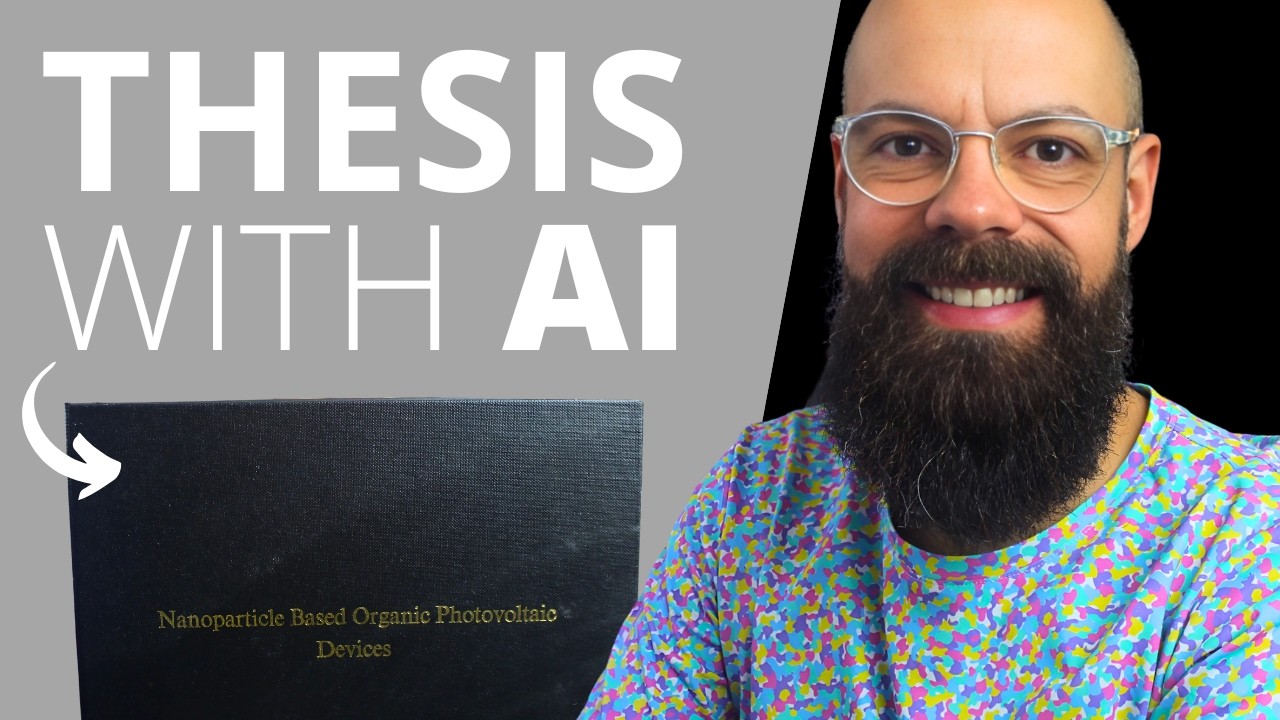
12 to 15 sort of like figures per chapter And so if your field has more or less you know what you're aiming for So that tells me I need to get together about 12 or 15 references to put together into a research story And then that's where the AI magic comes in Check this out All right I want to use AI vision And one of the best vision tools is Chat GPT You can upload figures like this and you can just use a simple prompt like this These are figures that are forming a chapter in my thesis and these ones were originally in a peer-reviewed paper And then so suggest
a story structure for the outline of this chaper No no Andy it's a chapter All right then So you can see here it's given me the chapter It says there should be an introduction to that chapter Obviously that's what you need But we're not going to sort of like touch on this just yet because there's going to be other ways to write that small introduction later in this video So stay around But this is kind of like what it's saying it should look like fabrication process which is great because we got this schematic
which shows how they are made And then going on it says electrical properties So this now gives us a structure to work with It tells us the logical kind of flow that chat GPT sees from your data So upload a load of figures and see what story structure you can start with After that we have the story structure slotted in And then we need to actually create the words to support the figures But starting with the figures means that you just know where you're heading And I like to work bit by bit building out as we go And that's where we start The next
step I actually come away from the computer And you'll see what I mean All right then So once we got the story structure we need to actually create content around the figures that sort of like create that chapter So now I head over to my actual sort of like phone And the reason I do this is because there is a button which allows me just to talk directly into chat GPT Now I like to use my voice but you may differ You may just sort of like writing But for me the way I like to do this and I think you should try at least once is by talking about the figure randomly Just say stuff that
comes off the top of your head and it will turn it into a really awesome paragraph So for example here I can click go and I can say this is a figure that I want to write about in my thesis It has four panels A B C and D And in the first panel A we can see there's a silver nano wire network And it tells me that it's a 34.7 plus or minus 10 ohms per square resistance And uh then in panel B we have it with single ward carbon nanot tubes And you can see the
sheet resistance drops to 15.2 Um you can also see that the single ward carbon nanot tubes wrap around the silver nanowires and they expand out into the gaps between the silver nanowires Uh and then you go on like that and then we push go and then it says convert into text So this is what I ended up talking about You can see this is like the kind of really random stuff the thoughts that come off my head and you can talk for you know 5 10 minutes about a single figure It turn it into um you know text and then the prompt is turn this into a
paragraph for my thesis and then it says here figure X presents a four panel comparison of s silver nanowire and modification with single ward carbon nanot tubes and then it gives me something to work with If you do that for every single figure that you've put into this chapter then you have a little thing under each figure which then builds the story that is so important because now we're going from like just the structure to the figures and now to the text And that's how we build out this thesis step by step If you think
that was cool check out this next section where we really use the power of AI to its full potential After you've got all of the story and you've built out the text around that story then the results and discussion section now you need to go on to the introduction section The introduction section is going to be very very important because it's going to introduce all the concepts that you need to talk about in your thesis and it's going to give the background the foundational knowledge Now as you're going through your research you should have loads of references that you're working with So if you have loads of references to
create the introduction section to your thesis you can use one of these two tools The first one I recommend you look at is notebook LM And so here you can see I've put in 20 something papers and this is what it's ended up with So I say I'm a PhD student writing my thesis write an introduction section to my thesis based on these sources And you can see here that it's given me this kind of quite short um structure Now Notebook LM isn't super good at producing loads and loads of text So I
did say it needs to be longer and it did make it a little bit longer And you can see it's all reference But down here this is where it really comes into its own I said "Create an outline for an introduction section that could be expanded into 20,000 words." And that's approximately what my uh introduction section is for my thesis And you can see here it's done much better with the outline rather than the text um you know dump that it did before So here we've got the different structures And this is now not only just the sort of like structure but it also includes the
references to support the claims that it's saying that you should uh you know mention in your introduction And you can see this is so much more detail than previously So this is how I like to work with notebook LM is given structures and then you can use exactly the same process of talking in to your uh phone on chat GPT to sort of like flesh this out But there is a quicker way Now this is the only AI tool that I found that does one prompt introductions to your thesis like a literature review or even the beginning of a peerreview paper So
if you have the references this is where I would go So head over to thesis AI and you can put in up to 100 reference papers to be cited I've done this previously and you can see that it produced up to 17 pages Now my introduction in my actual thesis is about 20 pages long So this isn't far off the entire introduction for a thesis So you can see it's completely referenced and you can also take this It gives you a nice little abstract as well actually Um but also you can uh put this directly into something like Overleaf
and have complete control over the citations over how it's laid out So you're not locked into anything And the fact that it just spits out so much information about you know all of the stuff that you've given it in terms of references I don't think there's an AI tool that does it better at the moment But your mileage may vary So let me know in the comments if it works for your field but I've been very impressed with all of this and that's how I would write the introduction section to my thesis Um if I had all of the references this next section is bloody awesome I use this
technique all the time inside outside of academia Check it out Now you naughty little thing maybe you don't have all the references that you need to write your introduction So I would start using deep research technology and the new sort of like features that it brings for writing an introduction section to your thesis And I think the best one at the moment is Perplexity AI So Perplexity AI allows you to put in a prompt and ask it for deep research for free Oh I love the for free bit So here it says "Research
single ward carbon and silver nanowire electrodes for the introduction section of a thesis Write the introduction section to the thesis based on the research." And so here you can see we've got quite a significant amount of research and data in a uh you know an appropriate format Is it the best thing that you could just copy and paste across No obviously not But it gives you such an awesome starting point if you don't have the references that you want to work with So then I would take all of these references I put them into my citation manager and then I sort of like build out my introduction that way So if
you don't have references deep research at the moment is your absolute friend when it comes to sort of like building out something like a literature review or the introduction to a thesis Stay around to the end because I think after watching this entire video your writing will never ever be the same again So the next step is like what about the other sections like the conclusions like the abstract Well I like to use kind of a step-wise approach for actually getting the content in there So you have all of the conclusions from the different chapters of your thesis So here we've got conclusions we've got conclusions
we've got conclusions and then we need to combine them So I would put these into chat GPT or your other AI model and then I'd ask it to combine the conclusions from all of the chapters into a like mega conclusions So that's just a really simple way of making sure that you you know don't miss anything and then you can have it reference back to certain um chapters You can say like these are the conclusions from chapter 1 these are the conclusions from chapter 2 these are the conclusions from chapter 3
combine it into a conclusion section for the end of a thesis and then you can end up with a nice sort of like draft of that conclusion section of your thesis That's how I would approach it anyway Or I would just sit and talk into my phone like the method you saw before Easy peasy lemon squeezy Actually interestingly the method section of your thesis is where AI is probably the most useless because you know what you did in the lab and you should have sort of like a record of the things you've done the techniques you've
used the instruments you use the products that you bought All of those things are just things you need to keep track of But you can put that into an AI system like chat GPT Perplexity Claude whichever one you like and just say you know here are the methods that I've used Write a method section for my thesis That's how I would do it But really that is the most manual part of a thesis using AI at the moment Now we have a load of text that we need to make sure actually meets academic standards What do we use Well there are two tools that I would use The first one this is paper
pal in a nutshell You can see here that I've got one of my papers here And along the side it just gives you all of the things that you need to kind of like change and all of the suggestions that you it recommends that you do to keep it up to academic standards There we are So we got PayPal apps for Microsoft Word We got it for Google Docs got it for Overleaf So having this as you are writing alongside um you know your work is just going to help you keep it up to academic standards But there is a better way to actually check all of your stuff using AI tools and the best tool at the
moment no doubt in my mind is Thesify Theify isn't free but it can actually do a lot of the heavy lifting that your reluctant supervisor doesn't want to do So here you can perfect your academic writing with confidence And this is something I've done before I've put in my peer-reviewed paper and you can see here you get loads of feedback You get feedback you get a digest you get resources collections all of these things But ultimately this is what we want on the side Feedback summary is what works well what can be improved in the overall assessment And then it's got recommendations If we collapse that and
look into suggested topics or purpose so let's go into purpose You know these things I've done well but there's some things that I can improve So this is looking at your peer-reviewed paper or your thesis or your writing You know put an entire chapter in here and it will tell you where you're not making meeting academic standards It is like a supervisor who is actually willing to help you and is ready there and waiting for you to give it its paper It's not like oh yeah it's still on my desk I'm afraid or I'm off on sbatical to France
for a bit whatever We know you're just going on holiday Anyway this is like a great place to put that first draft before you even send it to your supervisor And it will give you all of the different things that you should change to make sure that you're actually sort of like meeting the highest of academic standards That's how I would use AI to write a thesis And it's like mashing together a load of techniques to work powerfully for you Let me know in the comments which one you like And if you like this video go check out this one where I talk about how to write an
abstract using chat GPT I think you'll love it, YouTube Video IDZOJeSejQk, YouTube, 01kac313xq34nmsas861zg9dhg.