YouTube Video dPVcqtTdBmg
## Metadata
- Author: [[YouTube]]
- Full Title: YouTube Video dPVcqtTdBmg
- Category: #articles
- Document Tags: [[governance]] [[sustainability]] [[technical]]
- Summary: YouTube Video dPVcqtTdBmg
- URL: https://www.youtube.com/watch?v=dPVcqtTdBmg
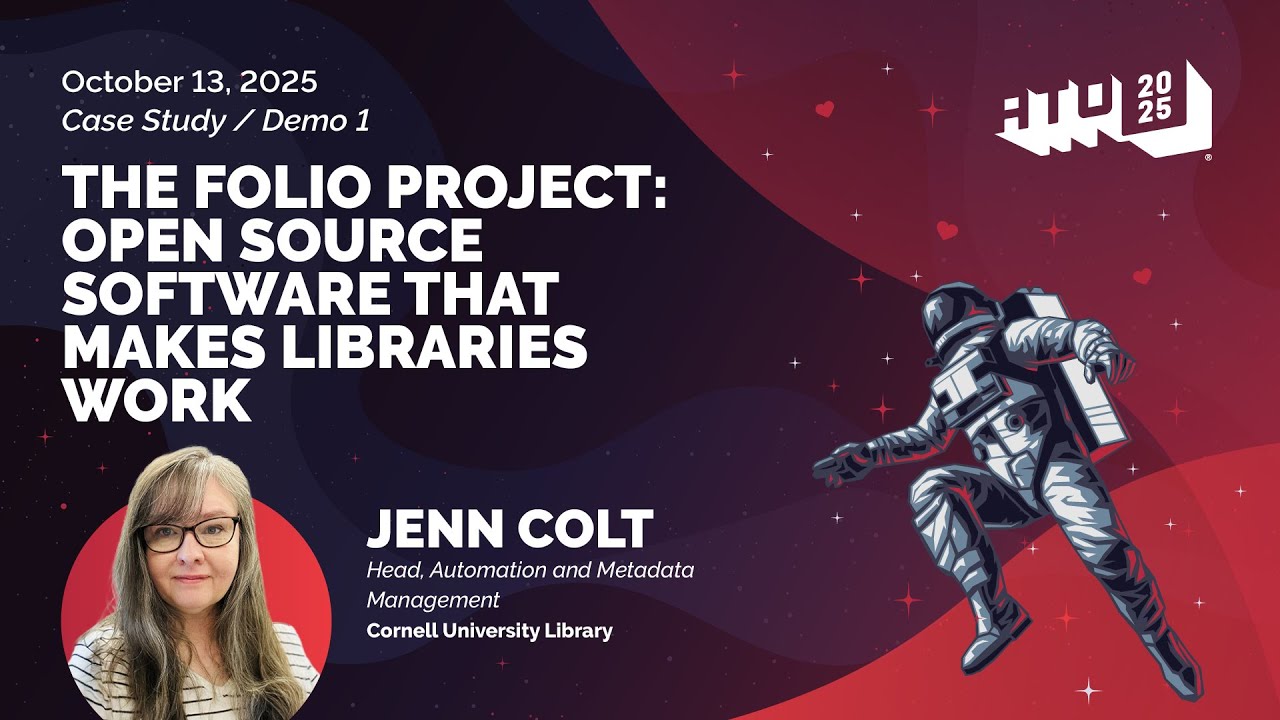
So, my name is Jennifer Colts and I'm actually a librarian. I work at Cornell University Library, so I feel a little fish out of water here. I'm like sitting here imagining what it would be like to work at some place like Capital One. Um, the university is obviously really different and I have a little bit of paranoia that someone saw my presentation about open-source software
that makes libraries work and they thought I meant like the other kind of library and so they let me in. Um, but hopefully it's okay. So, this is kind of a case study presentation about this particular piece of open source software and the community that goes with it that Cornell uses. and um a growing number of academic libraries use. So Folio stands for the future of libraries is open um
and it's a collaboration among libraries, developers and vendors to build an open-source library services platform, which is one of those phrases. Anything that includes the word platform is sort of another word that you can have a bunch of arguments about. Um I'm a librarian, so arguments about words. Um, but essentially this is software that lets you run your library. So it does the things that you can imagine needing to do. You can catalog books in
it. You can do circulation, check things in and out. You can do your finances. You can do ordering, manage your staff, manage your patrons, and you can integrate with other library systems. Um, in case folks don't know, academic libraries especially use and produce a pretty good amount of open source software. Um, our cataloges, archives, repositories, preservation systems, and generally just that support of open scholarship that we undertake. Um, so we
have actually um for the libraries that have the resources for it have a pretty good relationship with open source. So some details about Folio. It's got a micros service architecture um with modules and applications that libraries can pick and choose from. It's developed by a large set of distributed teams that are mostly funded by vendors and library networks that host libraries
who are using Folio. So, so they're doing software as a service um and putting money into development of Folio as part of building that business. The project's got, you know, 400 sprawling GitHub repositories, 400 GitHub team members, and 91 GitHub teams. And the developers are throughout the world. There's a fair amount of um cont contracting. So, the developers are really everywhere. Uh here's just a screenshot of Cornell's
installation of Folio. There's a book. You can see that it's at Urus Library. It's not checked out right now. Sort of what you'd expect uh if you're wanting to run a library. So the great thing about Folio is that it entered the marketplace and gave large academic libraries an open-source option. Whereas before the options were largely closed source with a couple of exceptions that weren't necessarily at
the level of functionality that a large institution needs. Um, so this gave libraries an actual choice where there might not have been one before. And this library technology guide site um does a bunch of reporting on library technology. And almost all of these migrations to Folio are from a closed system. Um, and some of these closed systems are owned by really large conglomerates who really want to own
all of the academic knowledge production, if you can imagine such a thing. And so having an open source option that lets you kind of get out of that monopoly is pretty great. Um, Folio is all over the world, which we're really proud of. And as you can see, it's mostly academic libraries. There are some public libraries, some special libraries uh and mostly uh libraries on the bigger side adopting Folio. And when we talk about
bigger for libraries, we're usually talking about the number of items in their collection. So like Cornell owns about 12 million items. um a much bigger library. The the Library of Congress reached a major milestone in bringing collections to users earlier this summer and that milestone was uh going live on Folio which we were super super proud of. Um so the community like I said is composed of the libraries along with
software vendors, hosting companies, consortia and individuals. Anyone can come along and participate in the Folio community. Uh but you can also join as a member and paying dues allows you to be elected to one of our councils which is our our governing bodies. So we have a community council that deals with funding and membership, a product council that deals with product vision and manages the special interest groups and a technical council that deals with
standards and best practices. Um and I'm right now I I think I forgot to say before the co-chair of the technical council. We have a lot of special inter interest groups. So sort of every area of the library like the catalogers have a group, the acquisitions folks have a group and so on. And then there's also the development, DevOps and release management teams. So these are just some of the members. EPCO is the most um the person the person the organization that has sponsored the most development uh in the
project and then these other folks are also putting in um membership resources. So I thought I would tell you about our problems partly because maybe I'll get some advice um and uh I feel like our project is set up a little differently than a lot of the other projects that I hear about here. I'm really interested in community management and governance. Um, which is why I like coming to this conference. Uh, but I do feel like we're
a little strange. So, we have a perhaps not unfamiliar challenge that we've got one vendor that's done most of the development in the project. And of course, this leaves people feeling really nervous about sustainability. You know, what if the vendor decides to go live in the woods uh or just do something else? Um and then also about what influence looks like in the project when there's one organization sponsoring so much development.
Um another challenge we've had recently is the vendor that is doing all this development uh made a really low-level change to our API gateway and authentication. So we had had a homegrown solution. They switched to Kong and Keycloak which is fine. Um, but that was a big change to make and it was really challenging to get the community to to accept that change and move along with them uh and not end up with a fork or something terrible.
It is hard to manage expectations around influence. Uh, people become members. They have their folks participate in SIGs. People spend a lot of time testing. Uh, they're really invested in this software. they want it to work well for their library, but they don't necessarily end up with the amount of influence over the development road map that they might like. Um, so there's a lot of managing influence and the expectations
around influence is is really hard because no matter how hard you volunteer, it's never as much as somebody's $25 million contract. Um, and so that's really tough. our governance structure. Um we have these three councils who are elected. Um and that does include folks from you know the vendors and the universities and so on. Um but those folks aren't part of the development teams necessarily and so
there can it can feel like there's a lot of distance between the decisions governance is trying to make and the day-to-day work that's going on by the development teams. Uh and then we have sort of normal open source challenges around things like funding and changing licenses which has been a big thing lately. Um and then we have some more specific challenges facing libraries and higher education right now. Not great. Um and our poor friends at the Library of Congress of course cannot even work today.
Um so challenge management I thought I'd give a little bit on what we've tried at least. Um, so we have put a lot of effort into increased transparency and communication. The product council is trying to collect input from the community on what their development priorities are. You know, you've seen other places where they do like voting on this or that feature that people want. So, this is a slightly more because the product is so big, it's a
bit more complicated than that. Um, but that's the kind of thing they're working on. uh and then making sure that those are documented so that teams and funders can find them. Sorry. The product council is also trying to produce kind of a communitywide roadmap that brings in plans from all directions which is as hard as it sounds um because you have multiple vendors developing for multiple clients. They don't have to
tell you what they're doing. Um and they you also are not always a priority for them. So even if they're perfectly fine sharing the information, they have to find the time to get it to you and that sort of thing. So that's really challenging. Um we're working on providing technical support when a big change does come along. We had an early adopters program for the Kong and Keycloak change to like give folks who were willing to step up and try some hands-on experience and
mentoring. Um, and we also provided a lot of social support, a lot of meetings, a lot of trying to get buy in, um, to really try to avoid it. It felt like a very dangerous moment for the community where a fork really could have happened. Um, so we really spent a lot of time talking to try to avoid that. And now we're trying to pick up up the focus on fundraising and increasing the number of paying members to improve that
sustainability and hopefully potentially come up with some better balance in the influence so that if there's money coming from more directions, having just that one organization outweighing everyone else so much might get balanced out a bit more. So things are not all bad. Um the adoption of Folio is going really really well. We're so proud to have the Library of Congress. Uh we also have other national libraries like National Library of Sweden in Australia. Um, as I said,
the marketplace for this kind of software was really contracting in terms of choice and this successful partnership, even though it is uh difficult um that we ended up with this really highly functional piece of software that lets people not be locked into a single giant company um is a huge win for libraries. The community-based nature of Folio
means that libraries can actually see that the things that matter to us are incorporated into the software. Um, privacy by design is really important for libraries and having a say in how the data is handled in this software is very important to us. um building this big open source community has given librarians and library staff like a lot of opportunity to skill build um and to network which has been great. And last um you know it
kind of feels like libraries and open source software communities fight similar battles for freedom and freedom of knowledge. Um, and we really appreciate all the projects that our software builds on and we thank the open source world for helping libraries serve our patrons better. So that's it., YouTube Video dPVcqtTdBmg, YouTube, 01kac3wfe88t68e4q71622j6g7.