YouTube Video kywamfxOAu8
## Metadata
- Author: [[YouTube]]
- Full Title: YouTube Video kywamfxOAu8
- Category: #articles
- Document Tags: [[ai]] [[collaboration]] [[docs]] [[education]]
- Summary: YouTube Video kywamfxOAu8
- URL: https://www.youtube.com/watch?v=kywamfxOAu8
Hey everybody and welcome to another Kinsta Talks episode. My name is Marcel Bootsman and I'm the Partnerships and Community Manager for Kinsta in
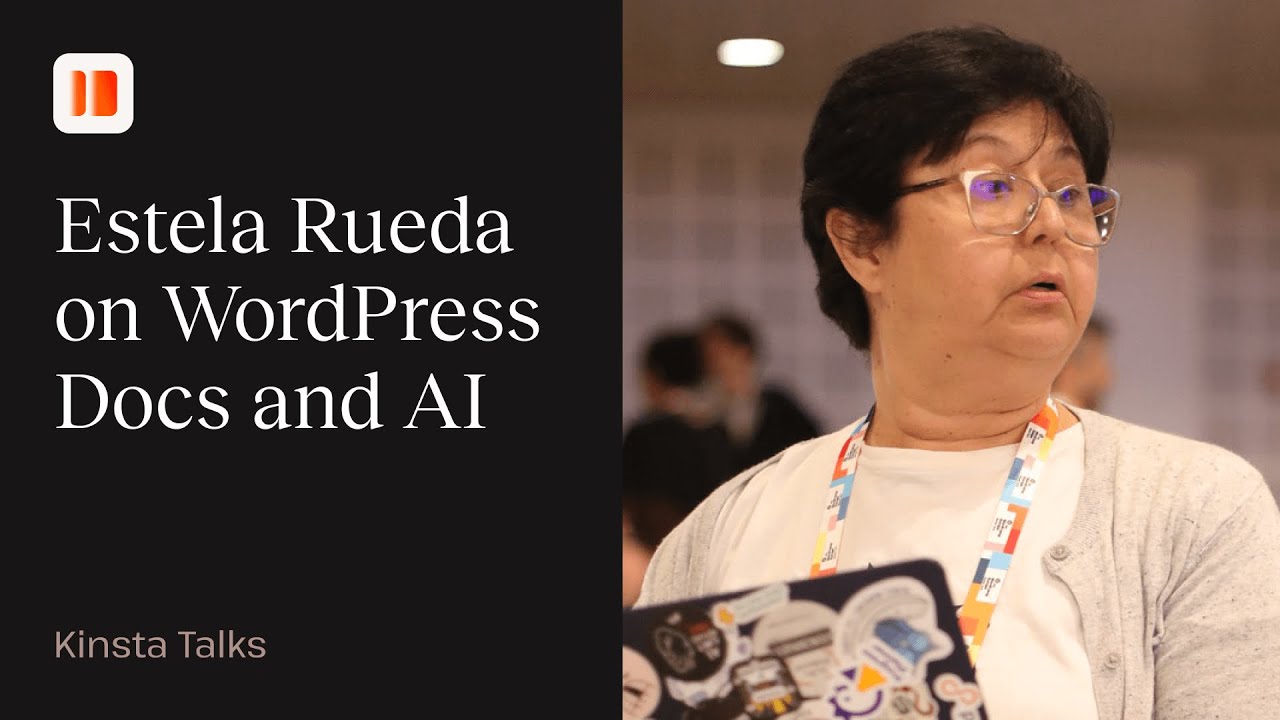
the EMEA region and today in the call is Estela Rueda. Hi Estela! Hello Marcel, how are you? I am good, how about you? Excellent, that's good to hear. You look great. Thank you. Yes. Okay, so Estela is a long-time contributor to the WordPress project and she can probably
introduce herself in a few lines much better than I can.
So I'm going to ask Estela, please give a little introduction about yourself. OK, so my name is Estela Rueda, AKA Estelaris in the WordPress world. I've been a long time contributor to the WordPress project. Right now, I'm focusing on the documentation team. My biggest contribution to the project as of right now has been the redesign and re- categorization of all the user documentation, which I did.
That was a huge two-year project, which was amazing. Obviously, it wasn't just me, okay? I just kind of led work on the hard thing, and the whole documentation team took part of
it. And that was it. This project came as a conclusion from moving all the documentation from the Codex into
WordPress. But then they did not categorize it properly, didn't work properly in WordPress, and it
was very confusing.
So yeah, I tried to make it easier for the users, for non-developers to understand and
find out where things are. And then this, because I wanted to change the page, I kind of planted the seed for the
redesign of the WordPress.orgs, which I am glad... I helped a little bit, I participated a little bit in the project, but yeah, it was a fun
thing to do. Cool, that's a good introduction. Thank you, Estela So Estela is being sponsored by Kinsta as part of the community
sponsorship program.
I want to, because your introduction, you mentioned the Codex and I want to, I have a
question already. I learned that the code, well, I started with WordPress when I was operating an agency for
myself and used the Codex a lot because I was a developer back then. use all the information that was there and we're not going to discuss whether it was
complete or not. It was there but since this all has changed to a new documentation area where all things
are being updated but the Codex is still live are there any plans to to sunset the Codex?
Yes, there are, but it cannot be entirely sunset because there are locales that still use
it. Like for instance, one thing that happened to it was the Japanese one. It was in Codex and then they moved it to another site that some, I believe the hosting
company, disappeared and shut it down and they lost everything.
So they had to start all over again. Then I believe the Russian locale still uses the Codex and only uses the Codex. And there are several locales. I mean, I know those two because I've been looking into them. But I do not know anybody else. I do know that there are several. The English one, they've been trying to. close it little by little, but once in a while, Google algorithm, and once pops up up
there, we tried to delete it, but it's But yeah.
I understand that the Codex then is a place that cannot be sunset this easily. Because also, correct me if I'm wrong, the English Codex pages are like the starting point
and based on the English pages you have all the translations in the locales, right? I say so. I'm not sure because I did not work on the Codex. I have no clue how the Codex in translations were started or developed.
So no, I don't know. But yes, do need to have. When we find pages in English, the algorithm pops them up again. We redirect them to the correct documentation that we have right now so that we're in a
way of trying to kill those links. But yeah, URLs will still exist. Yeah, of course, some, well, because all the new place for documentation, if that replaces
the Codex information, do you also remove the Codex information from the page, from the
Codex page and still keep the Codex page live with a link to the new location? I will not know because that's been done in the backend and only one person has access to
that and he is the only one responsible for... We just gotta go click like, DD please can you fix this? And there he goes. Yes, okay, that's, I understand. Okay, let's not go into the Codex then too deeply.
Let's focus on what you have been doing. What can you explain a little bit what you have been doing since, what was it, end of June
that we had our last call? What have you been doing? We've got 20 minutes, so be... quick. First of all, we've been working with the release team. We were not aware of one thing that happened with the release teams. They decided to, a decision was made up there in core and somewhere that we didn't know,
we weren't aware of.
to make an experiment and reduce the size of the release teams. Because, we were having release teams of 20, 30 people, of which only, you know, it's like
when you're in school and you have those team projects, only two of them work and the other four just, you know, hang out. So it was happening the same thing. So they're trying to reduce the size, but they... remove documentation from the release team.
And we cannot really be removed because a lot of our work depends on the releases. yeah, we need to try to have it all. Besides, we were trying to have this experiment of releasing documentation written by AI
for 6.9. We were removed together with other teams, right? We kind of, you know, it totally threw us off base. So we talked to the core team. We discussed it with Mary and, you know, we tried to make them understand it like we do
need to be.
There are two things that are important. One, we need to keep track of everything that they are releasing so that we can write
documentation for it. And second, it is a lot about perception. I made this comment and I will say it. I was not aware because they called me and I helped with 6.8 and I was not aware of
anybody doing the documentation in there.
that we didn't have a documentation team lead in 6.8 either. And I don't think we were aware of it because we don't participate in all of them. The main teams, we try to let other team members be part of the release teams so that you
don't see the same name over and over and over again. And we also, because we like to mentor other people and distribute responsibilities. So when I was at WordCamp Europe during Contributor Day, I was leading the table and
somebody approached me and they said, like, what is this team?
said, documentation. And we were talking about it. And then this person said to me, well, no, you're not even part of the release team. I'm not going to waste my time here. know, something like this is a team that is not worth it. Something like that, he said. I don't remember exactly what this person said. And because I know people make dumb comments all the time, I just kind of like brush it
off and like, you know what, you don't want to be here, just move on. I got things to do.
And I didn't care about it. But when we had this discussion and when I realized what was going on, I'm like, OK, this
comment is important. And not the offensive part. I'm just going to remove the offensive part entirely a bit. But it is important because there is a perception to it. First of all, let's face it. Documentation will always be the ugly duckling in software development. Nobody wants to be in documentation because it's boring. Yes, it is boring.
But like I always said, try to build an IKEA cabinet without the instructions. And let me know how it goes, right? It's the same thing. Yeah, you call it boring, but sometimes the boring stuff is very necessary to have it is. is. That's what I said. We will always be the ugly duckling. But when we develop, then there are beautiful things coming in there. So I tried to explain to the core team. The core team is like, well, we appreciate what the Docs team does. But no, we cannot have you.
So we talked to Mary. You know, a whole discussion. I'm not going to give you the details of it. The whole discussion, we agree with Mary to have right now a Docs liaison. for 6.9, where we're going to work on our own. And then I'm just going to work with the team, with the release team on the release day so
that I can prepare and release all the one, two, three. I think there are five, six pages we need to release on release day about the version, all
the information about the version, updating another page.
There are several pages. There's a lot of updates that. that we do take care of. And giving them a list, I mean, they have the list. Still, after 6.8, in the middle of the way, I'm like, we need to update this page, just
because you said you weren't going to do it. You didn't do it.
So they have the list. They don't always do it. I always say, I don't know if it's the OCD in me or it's the people do not read. pages entirely, instructions entirely, or they just of wing it. they're like, know, like wing it. you know, I just update these two pages and I'll move on. It's not like that. So we agreed to do this. now we're moving on.
We're happy. At the end of this experiment, we are going to have a discussion about whether yes, the documentation team can be there. And they are going to evaluate whether a smaller release team is better than a larger
release team. But this time, we are going to be invited to this discussion. Because Mary said, I don't know why the documentation team was not in here in the first
discussion.
Yeah. wasn't aware of it. And she said, that's a big problem. So I'm like, OK, fine. Let's just not hang in the past. Let's move on. Let's progress. Let's let the experiment happen. And then we can evaluate what's happening. And she's like, OK, cool. We move on. I already gave a lot of feedback to Mary and what we have written in the documentation
blog, make blog. uh We're good on that aspect.
Now moving on. 6.9 AI. one of the biggest reasons for this sponsorship is that my intention was to write
documentation with AI to speed up the process, help us, and try to make sure that we finish at the time the release is happening because we are never on time.
We get the updates kind of late, and writing the documentation really takes time. So I've been doing this. I've been doing experiments a lot of it. But I have learned something like horrible, horrible, horrible, big lesson. The learning curve is not that simple. Learning AI is not that simple. You know, everybody, I think that by now when we are in software and we're working on
this, we kind of have an idea of concepts, concepts here, a concept there, a thingy here, a thingy there, but we don't put it all together.
At least I did not. I have three use cases that I wanted to write on my blog about it, but I wasn't sure. I was still unsure about what I was doing. And somebody recommended me to take the Google AI basics. certification which I started this week and I realized that I'm doing the right thing but
I went on the wrong with the wrong approach because like I said I got one concept from here one concept from there one concept from over here and I made a mess so I have the
thing I have my starting point and my end point on
all three use cases, I just need to redo the path with the correct uh approach this time. So I would be doing that, because I got to hurry up so that I can finish 6.9 and give time
to the reviewers to review all the documentation. And then once we do this, I will go into document everything that I do on my personal
Gemini, because I think I'm to work with Gemini this time. And then once I create all the documentation, I am going to meet with the AI team, the
core AI team from WordPress, to see how we can integrate all of this into what they are building. Because something that I just learned, you can teach the LLM.
But you will teach your own system. You don't teach it globally. All the data that goes into it, it only updates whenever they update the tool, the AI
tool. Something I didn't know. I thought it was you put it in and it becomes live immediately. Well, no, it doesn't work that way. So I think that I need to find out them. the AI team, sorry, how can we approach that in a way that we can all use one system so
that we can teach it and we can update documentation and create new documentation with
what they are building. It sounds like a huge challenge. And a lot of people, they say AI is going to help us, but we need to train AI also and to
understand a little bit more about the process, about your approach, whether you failed
the first time, you know, or need a lot of improvements, it doesn't really matter. But the global approach, you know, we have a release schedule for 6.9. It is planned for December 2nd. Yes. 2nd is the release date, the planned release date. Until that time, are going to be beta releases. There are going to be release candidates. In a practical way, there are a lot of features going to be added. There are things going to be changed. How does your workflow look like if we pull out one feature? How do you write the documentation also together with the AI thing?
OK, so there is one post that is on the core make that is the roadmap. Everything that is in that roadmap, the 6.9 roadmap, there is a post for every single
release. So we keep everything in there. So what's in there is what is going to be built. So this is what we're going to turn in for this release. When something happens and a feature is not going to be released or is not going to be
updated or it's just not going to go through, this post gets updated.
And there is a note at the bottom, update. Feature A is not going to be updated because it makes or has a conflict with feature B. So that way, we keep track. We always do this. This is how the core teams and the release teams work. Okay, You mentioned the roadmap of all the features that are going to be included. Where can people find that? On make.wordpress.org slash core
Okay, so here we go. It is in here and it's right here. So, roadmap this is, yeah, this is the 6.9. No, this is the, no, so sorry, so sorry. This is the main roadmap Then it's gotta be this one. Yeah, there it is. And on the top it's roadmap. Yeah, there it is. And roadmap to 6.9, all the contents. And you see it is right here. As always, you know, everything is going to make it.
It says perfectly clear. Now, this is our intention. Sometimes it doesn't make it, you know, and um sometimes they make uh updates at the
bottom. Change log. There you go. remove an initial, see everything that happens when we change things, that's where it
goes. yes okay good it's good to have this Yeah, you can have that on the...
uh Stop sharing. There you go. so there is this nice roadmap to the 6.9 release, which basically contains all the things,
on a higher level, what is going to be changed slash added in WordPress 6.9. Based upon those changes, Do you already begin with creating like a template for documentation about these changes?
That's what I did with AI, but I did it wrong. So one of my use cases, the first one that I started with and it's one that I wanted to
start is because this is my my initial thought of teaching the LLM, the language of WordPress. So the first post that I, on my first use case was, what is the difference between
WordPress.com WordPress.org and WordPress the software. Because I keep asking ChatGPD and ChatGPD insists that we can monetize WordPress.org.
And the reason for that is because ChatGPD does not know the difference between the .org,
which is an editorial site, and the software. So that is a thing that we need to, that's one little piece of information of data that
the LMS do not have. And that makes the whole thing confusing, exactly.
But that makes the whole thing confusing. The minute that you tell somebody, I can monetize WordPress.org, but where? I'm like, no, you cannot. Nobody can access that site. So yeah, that was my first thing. then the second use case that I used was creating, I asked it to review an article that we
already have. And then I gave it two updates from previous releases.
Gutenberg release and a general WordPress release. then I gave it that, and it gave me an updated document that's not so accurate, but OK. I'm like, I'm good, I'm good. I also fed it our style guide, which is very important. And then my third use case was grabbing that roadmap, and I asked it to give me which are
the end user features that are going to be new releases or updates.
And it didn't give me too many. So I got to go back and review it. It didn't give me too many, but it's getting there. So these are the things I need to teach. the LLMs but then I decide, okay, I gotta do either ChatGPT or I gotta do Gemini because
yes, it is all about prompts, but I've noticed that they think differently. It's a, analyze different, they don't think, they analyze differently.
And I think that I'm gonna stay with Gemini for this and finish it up in Gemini. I like to use ChatGPT for other things. I didn't like the way analyzed or the results that it gave me when I asked it to analyze
an article. But ChatGPT gave me an awesome summary on a YouTube video.
Okay, yeah, that's a different thing. Gemini could not give me. But you know what's the difference in there? The Gemini keeps telling me that they cannot give me a summary on a video while ChatGPT
can. And I'm still unsure if that's because that has to be a paid feature. I haven't paid for Gemini. I do pay for ChatGPT, so it might be that. Because the roadmap has videos, if you haven't noticed. they need to analyze those videos you know the LLM needs to analyze those two videos or
three videos that are on that post so that they can give me the correct
articles or features that are being updated or launched for the first time. introduced. So basically, and I think that's good thing to discover is that if we want to use AI to
enrich, help us creating the documentation, we need to focus on getting the right one.
In this case, it probably will be Gemini. Looking a bit further, you you mentioned that it cannot summarize the videos. I'm not sure if that's a paid feature. If it is, are there any options for the WordPress project to be able to use Google AI
Gemini in this case uh for our contributors?
will have, that's the one thing I need to check with the AI team. But because they are right now in the middle of building things and a lot of the features
that they are building are gonna come out for 6.9, which are all of them developer focused. There is nothing that is going to hit the end user with the AI right now. It's gonna be developer focused because they need to start in the back end. They need to start in the background and start building up all the way to the front.
But once I figured out my thing, it's just that I need to have the use cases because I
need to have the steps. I need to have the roadmap to see, OK, this is where I am. This is where I want to go. This is the path I need to take. So I created it. Now put it in WordPress. I don't know how to do that part. So that's yours. Go ahead. Yeah, I think it's very good that this is being investigated, that this is also being
documented.
uh You have to document how to create documents. Yes, that is perfect. Not just for yourself, but because we are a community, know, others might join and they
don't want to reinvent the wheel, you know. No, exactly, exactly. Documentation is very important, especially also for the documentation project. Mm-hmm.
And I think that another step could be, but that obviously this has to be, I need to talk
to Mary and Matt about this. If maybe we can approach Google so that we can update this data faster into Gemini. But then that will have to be a Mary, Matt question answer approach solution. Yeah. it's definitely a good suggestion because, you know, our documentation, the WordPress
documentation changes not only with new releases, but also in the meantime, you know,
stuff gets added, changed, updated. So it would be good to have Gemini update that as well. So yeah, that's a very good point to start discussing about that. To close off this nice interview, I have one remaining question. If people want to join or are interested in how the documentation team works, or if they
want to join how they can do that, can you tell us how they should approach that?
You are welcome to join us on the Slack, the documentation Slack. It's the Docs channel, D-O-C-S. And we meet on Tuesdays at 2 PM UTC. Well, every Tuesday we have a contributor day every once a month, which lasts three hours. Our meetings normally are between 10 minutes and then one hour, depending on who's around and any updates.
We take breaks in the summer, obviously, and Christmas time. I guess nobody shows up. But yeah, most of the time, that's when we meet. We also have on the, let me see, make, what's the link for that, for documentation? Make WordPress.slash docs. We have a pinned article in there that it's the onboarding videos. So you can go ahead and read.
And those are new. We update them constantly, even though the post says that it's from, I don't know, two
years ago, I believe. We update those. OK, three years. But the videos, we do update them constantly. New change, then we update the video. We change something, we update the video. So Milana does that. all the time and yeah, and we are going to start doing, we're gonna add also the videos to
the release, for the release team, but we're still working on the process.
have about, like I said, I told you that I had a lot of drafts happening. One of those is, you know, how is the documentation team going to work in releases and
because it's a... I don't know why the core handbook has it like a little bit here and a little bit there
and a little bit over there. So we're going to try to put it all together and tell them like, you guys got to fix your
handbook and just this is the way it has to go. Otherwise, people do not read.
People don't go chasing information that they know is going to require more work. That's one thing that we need to understand. So if you tell them, oh, you just have to do this. They will forget about the other 10 steps that they need to do. The other 10 things, they're not going to get done. And that's how other teams, whether documentation is, community or whoever, polyglots,
this is how we get stuck and dumped with a bunch of tasks that keeps us always behind.
Yes. or are interested to learn more about the documentation team, go to make.wordpress.org
slash docs. There's a nice onboarding post there written by Milana. Don't be scared by the publication date because it has been updated. So I invite people to check that out. Well, Estela I want to thank you for your time today to give us a little bit more insights
in the documentation process for
6.9 and I'm going to wish you all the best and fun in finalizing stuff and getting a grab
on your new procedure by using AI to help you document this. So thanks again and have a great day. Bye bye. too. Thank you. Bye., YouTube Video kywamfxOAu8, YouTube, 01kaeefvhjmwcn21pc895p8v47.