YouTube Video uRhTfu72Zcc
## Metadata
- Author: [[YouTube]]
- Full Title: YouTube Video uRhTfu72Zcc
- Category: #articles
- Document Tags: [[business]] [[customer]] [[visual]]
- Summary: YouTube Video uRhTfu72Zcc
- URL: https://www.youtube.com/watch?v=uRhTfu72Zcc
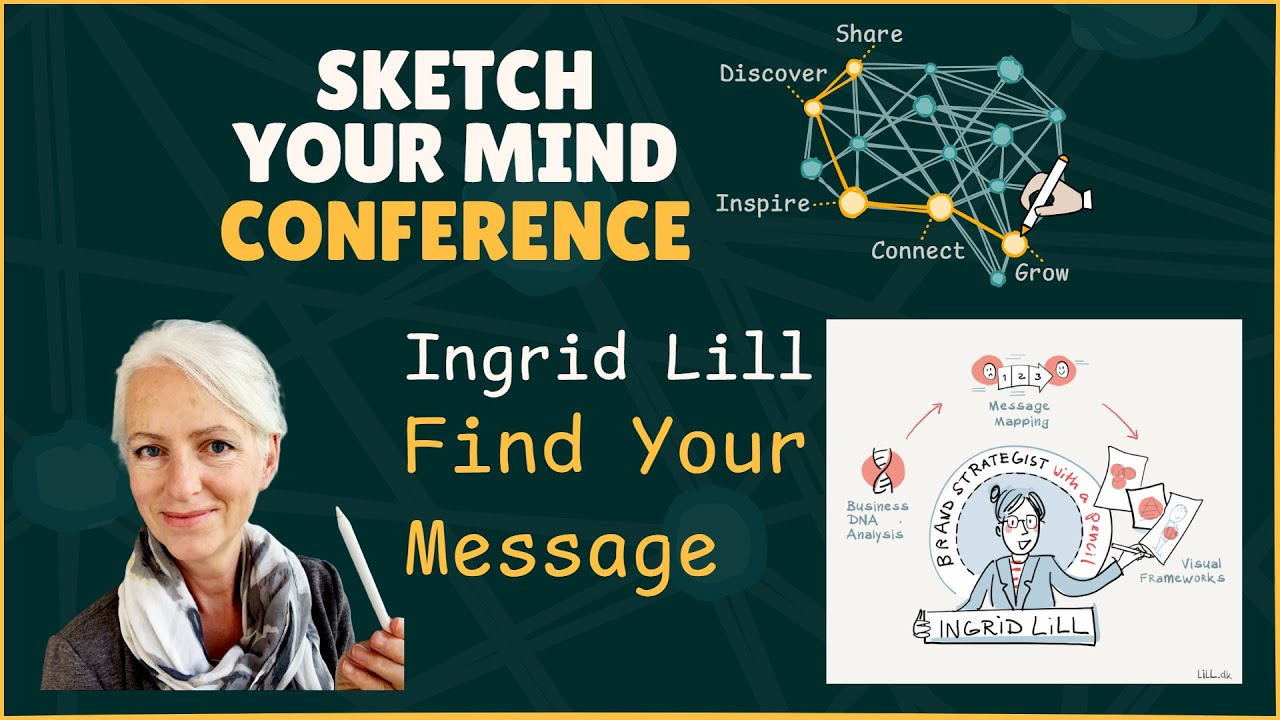
Hey, I'm Jolt. Welcome back to the Sketch Your Mind Conference recordings. We are now at session 14 out of 16. In this session, Ingred Leil shows how simple drawings can cut through all the noise and help you find your message. If you're new to the series, you'll find everything linked below, including the big excolatoral whiteboard where I'm
collecting notes from every talk. Ingrid is a visual artist turned business strategist. She helps founders and coaches get clear on who they serve, how they help, and why their work matters. Her approach is very hands-on. Sketch your identity. Map your client's journey from the problem pit to paradise and use those visuals to find the right words
for your brand. You'll also see her coach Shawn live using her framework to clarify the emotional journey behind his songwriting business. It's a great demonstration of how drawing forces precision and pulls out the message hiding underneath the fuzziness. At the end of this video, you'll hear the music I composed for this session.
And if you want to support my work, you can get the conference album, join the next visual thinking workshop, check out my book, Sketch Your Mind, or try the Obsidian Excolid plugin. All links are below. And now enjoy this wonderful session with Ingred. >> Yeah, my name is Ingred and I am a business strategist with a pencil. That means I help people
um figure out their brand, their their message, and I'm using my pencil for it because that's how I think. Let me show you how it all works. Oh, the the the program today is um I we we start with a little drawing session. First, I show you my my my introduction. Then we have a five minute drawing lesson and then I show you the
whole branding big picture stuff. Here is wait a second here. This is me. And now I'm here. Can you see that? Yes. I hope so. This this is me. I'm the brand strategist with a pencil. And uh what
I'm doing is I'm specializing visual thinking for business or I'm using visual thinking for business to help people map their method, see the big picture and then also share stories. And this is how I draw. And this is really really easy. Here is the and and I want to show you how easy is it it is to do something like
that. Here is a template that you can use to draw your brand in a nutshell. And let's do a like really really fast drawing uh session where I show you how I do my my figures. And it's not that you have to draw, but I just want to show you how how how easy it is. So, what I start with is a U
shape, then two dots here, a nose. And the dots should be a little bit like elongated vertical and then a smiling smiling mouth. So, with a big smile, you get a long way. use black pencil or black fine liner or or a black um pen in your digital drawing thing. Then this is my uh this is my hairo
as you can see as you could see but and and now the the the trick I will duplicate that if you're for example a man or you have a different hairdo then you can use exactly the same the same drawing and just draw different hair and here we have a man like a middle-aged. So, this is the type
that I I usually draw for uh yeah, business businessman typical. And then another U shape for the neck, shoulders, and this is it already. And if no the the neck shouldn't be too too flimsy.
So same here. But for example I am wearing stripes which come comes uh in the next step. But this guy has a suit which I do like this. So this is basically my kind of drawing and you get a long way with this kind of figure.
Um, and now a little bit of shading also goes a long way with a transparent marker or light some light color. You can put shading here underneath roughly under the hair for example on one side. If the color is light enough light enough then it
doesn't really matter so much where you where you put it here. And I have stripes. And this guy has a dark suit like that. This is how I draw my figures. And I hope you're drawing along.
The next part is so you you have that here. The more difficult part is so this was the how this is how to do it. like drawing can be really easy if you don't want to be uh if you don't try to be to do it perfectly. So and I I have been thinking how I fit with my with my stuff into the the whole
conference here. Um so there's two aspects to this visual thinking. One is how to do it. You can do that analog, you can do it digital. And then uh as some some people also showed like Joel for example uh what systems you can use to to link your notes and to organize your book or whatever. So this is all about the how. But there's another thing which is the
what. What is it about? So you can draw for yourself, you can draw for communication, but it's still what is it you want to communicate. Maybe you just want to draw. I saw that Brandy showed um a shopping list and that is for yourself. Or you can draw other people's ideas, but maybe you have a message also yourself. And um this is very much what
I focus on also to find out what to draw or what to communicate with this whole visual thinking thing. So to finish this here, if you have your your little figure, you it doesn't it doesn't really have to look like you. Um, if if you have the
uh the hair do more or less, right? And may maybe glasses. I'm wearing glasses now here. And then the next trick is to put a name here. Your name. Then I usually make a circle here.
And then the the hurdle for many people is what is your title? And this is for example also what I help people with to figure out what is it they're doing. So I am currently the brand strategist with a pencil and the thing is I'm a brand strategist and the pencil is my my secret sauce
with a pencil. So think about what is your secret sauce and then we can make another circle here. And I will make this here red because then it pops a little more.
I'm by the way drawing in Adobe Illustrator and if I'm on the I but if I'm on the iPad I draw in concepts that is my favorite app because it's also vector and then a speech bubble which then is your promise and my promise is for example uh clarity through visual thinking or
clarity for visionaries. And the nice thing is if you're digital, you can make make it a little bigger here. And if just a little trick, if you share a drawing like this, when you introduce yourself in a forum somewhere, it will
get attention. It's much better than just um than than just uh text. Am I still am I still on here? Maybe >> you are on. Yes. And everyone's listening. Yes. Great. So, I hope everybody has drawn their um their little figure.
What then you what you could do then is put on one side, we don't have time for for that now, uh your empathy and and I I will get to that later. uh why you love to help your your uh clients in if if if you're doing this for business and um what you struggled with some some something that shows them I'm one of you
and on the other side you can put something about your credentials your skills your certificates your degrees whatever or years experience something like that um I can or or what you can also do what I have done lately is like I did here this is my method so this is my whole process
and so I put that around it so that's up to you how how you want to present yourself but the whole thing is now um like a I call it brand in a nutshell Do you have any questions about that? Andre drew a woman and a man. Yeah, I'm
>> no no questions at the moment. I think let's >> I'm using Adobe Illustrator or Concept. Concept is actually great and uh and nicer than Illustrator. But this is what I've used for the past 20 or so years. So I'm I'm sticking with it. So this is the brand in a nutshell. And now I tell you I will tell you my story and how it all came about.
I because this is now the visual storytelling that you you can also do if you're if you're if if if you want if you want to use drawings or you can also do it with other means but um I wanted just to show you how how a visual story can look like. So I grew up in southern Germany in a small town and incidentally tomorrow I'm going there for high school re reunion. I was always the tallest and
felt kind of out of place in the whole thing and I was drawing all the time and telling myself visual stories until I started drawing only horses. Then it went sideways for some time. Then I went to art school and studied visual communication. By the way, this here is my uh creative genius that shows up once
in a while, my little mascot. Um, which was happy that I now am on my way to paradise. But I, this is a little bit later. I painted. I drew from nature. But I did not dare to illustrate anything. I just thought I'm I'm not good enough. I'm I I I couldn't do it. So this is very much me hiding
behind my work and trying to do art or doing art, doing art and thinking that illustration should also be art until I discovered and this was actually pretty late. This was when I was 55 or something like that or maybe a little earlier. I discovered that drawing can be communication
and that was such a breakthrough. I I can't even tell you. Um and this was when I found out how to do this little uh illustration that I have been doing that I've been showing you before that it can be just a circle and two dots and a smiling uh face or smiling mouth or or angry mouth or whatever. Um, and it doesn't have to have the any artistic quality. I mean, maybe it looks better
if if it has, but uh it for communication, it's just important that it's clear. So, I all of a sudden found out I had a voice and didn't hide anymore. I started giving uh drawing classes pretty fast after I discovered this drawing uh that drawing is easy. Now I'm running a membership called visual minds where we do all that and now uh funnily
I show people or I talk about a lot about taking up space because when you're drawing you should have space for your elbows. I've seen that when I gave um drawing classes in my studio that sometimes people were sitting there with a small piece of paper and elbows somehow in the air and and and and uh crammed to their body. So it's much easier and it looks it it will
convey to the to the expression of the drawing if you take up space. And I uh I suggest that you do that now and like stand up maybe and put your shoulders down and back and the arms outstretched and maybe up and then draw with this energy. And not only draw with this energy also if you have a business uh approach your business with this energy.
And now we come to the business part. So all this is good. So this was all the the how to draw and I was very happy that I that I found out how to draw and I was making money with most my money with graphic design. I did a little bit of uh graphic recording also but my job my that that that had been my or my profession. And
this did not go or after after so many years doing it. Um I was a good like a really good designer but the the way it all works wasn't I I wasn't happy with that. I wanted to help my clients on a deeper level. Not not just they that they came with something that made kind of sense sometimes not always. and then I should make it pretty. So that was wasn't
enough anymore. And but I saw that like completely separate from my um from the uh from the drawing until I took my own medicine and started using the pencil for thinking also and I developed a model. the this e before and after model for for marketing that you
can download. By the way, that is still my one of my main uh models that I'm using. And all of a sudden, I had something that I had a product that I'm helping my clients with like get clear. And before this poor visionary leader uh made these are all separate things se separate categories
social media website products how to how does it fit all together and if you see it as a in a list like this it uh it's very difficult for for some for some people for people like me and for other creatives to to make to make it make something coherent out of And ta these are my clients now after
this is um now they know who they are, why they're doing what they're doing or they they know they have known it before but now they have a system for it and uh they can talk about how they're doing it and who they are. They have a big idea and this is my model. So this was my story. Th this is let's
go back to here the share your stories part. And now we go backwards to see the big picture my system. So what you have seen before on my brand story board is this here. And this is the customer transformation from problem pit to paradise. Let me check
the time here. Oops. I don't have that much time. Uh here is the you that we we had before. Can you recognize it? It it is you are the pilot who is helping your client to get from the problem pit to paradise and you do that with your product and this model helps me so much uh sort information into buckets I I can't even tell you otherwise I
I would get so confused but if they tell me about all they're doing they're usually mixing up the end solution the the what what what people get out of it with their product. And when I have a model like this, I can sort it out easily and and then write it underneath. If you then draw the before and after like this, this is an exercise we did in
in visual minds. Um doesn't really matter. It can also be illustrated with photos or with words. But it's really really really important that you know what your clients are suffering from and what they want. So this is kind of the the key to all marketing. But it's not all. So in my model this is the visual minds
method. So here we have the customer transformation and this is the who who you help. Then there's also the how you're doing it, your process, uh your your the models that you're that you're using. Then there's the why, your mission. And the models here are uh your world models are a direct answer to the
what's wrong in the world. So they have problems because they see stuff in a in a way that is outdated or so. Do you see the truth and therefore you have visual maybe frameworks for explaining the the how it really works. So for example, this is my model and yours is probably something else. Then
you have a process uh oops this should say not this should say signature service. I don't know what I wrote here. um your process, what you what what you take them through the one, two, three process steps. And then you have your story, which is uh and you see there's this one big uh enemy that is making smaller
problems. I I get to that again. and you have experienced this problem too or you you know people who have experienced it but often it's yourself and then you had an idea and you're helping your clients. So this is uh the about your your backstory. This for me was visual thinking for business. For you it might be something else,
but maybe it's also visual thinking since we're in a conference about visual thinking. And then there's the business DNA, the the secret source, the the ide the the the big idea that that you have that makes communication just so much easier. here it's also in this in the speech bubble and you use it for aligning your team and for everything. So this is my model and when I work with
clients I have also visual templates for every single step uh the the business DNA we figure out with with this diagram which is an overlap of professionality and passion. This is an eeky guy uh inspired diagram. Then here is a uh story template heroes journey that
um you can use. And here is the the whole process. I have loads of diagrams to to clarify how you're helping people like what is their obvious goals a goal what is their hidden goal models can be any of these you probably came across them um
before in this conference and then but also how what is your signature service how do you um how do you package it? What here? By the way, it should be a freebie. So, this is also something that I'm helping people with. And >> the why >> Yeah. And maybe just because it will take some time. Sorry for that. I'm just looking at our time. If
>> Yeah. >> If you want someone to join the stage, maybe you want to introduce it. It will take some time until they can >> Yes. manage that and and then >> in the meanwhile you can >> yeah so this was the Whoops this is the the the model and what I suggested if if you want if somebody uh wants to volunteer I would take you through this very important framework here there
there is more to it but we can do any everything by the way this what would be your t-shirt shirt is a fun exercise. That's what I also wanted to say. Um >> yeah. So, so I think please please do uh talk about uh what would be your t-shirt, but in the meanwhile uh participants should see a join stage button and if you would like to uh volunteer for a quick real time
coaching uh with Ingrid then then please click join stage and then we can arrange that you're you get on screen and and you join the discussion but yeah so incred if you can still finish the discussion on what would be your t-shirt. I'm super interested. So, >> oh, Sean wants to join. >> Oh, and now the button should be there.
So, Sean, please. Uh hopefully you can see the button. It will take about a minute. So, so I think Ingred, you do have time for the >> for for the t-shirt. Yeah, it's it's just a a nice uh exercise. We did that in in visual minds also. Uh what what is a t-shirt? What message would you actually wear? And what t-shirt would your clients wear? And maybe maybe it's not it doesn't fit your uh it does not
fit your brand. Maybe t-shirts are not your thing. But it's it's a good um and and mine is actually the creative genius. Uh, and I designed a few t-shirts and now they're kind of disappeared. Maybe I can show them. T-shirts.
Yeah. Here's here's one of them. Mhm. I I have more. So, a kind of a fun little drawing also makes a makes these big claims more palatable and more fun. I find this
is uh an advantage of of drawing in your style. non non pretty. >> Okay. Where's Sean? >> Yeah. So, so when you join the stage, you need to go through a process of getting your screen or camera set up. Hopefully Sean is not on an iPad or um we'll we'll get through the process.
Based on experience, it usually takes about a minute for someone to And Sean is here. Yay. >> Hey. >> Hi, Sean. >> Welcome, Sean. Let me >> bring us up like this so we can see you and I'll disappear from the screen. >> Okay. Shall we do what? Tell tell me a little bit about what what you're doing. >> Well, I'm a I'm a a heart-c centered
music coach. Uh I call it actually soul-c centered songwriting. >> Okay. >> And uh I work with frustrated songwriters who are stuck in how to express their music. >> And what is it you you're struggling with most? >> Um myself or my my clients? >> No, you you to to start with. Then then we get into your your your client struggles.
>> Well, specifically in in terms of uh visual thinking uh because what I help them with is is expressing their music. It's I I'm I'm struggling to how to represent that visually um because it's more of a a an internal feeling uh experience and also in sound. And I can draw a guitar for example, but
um drawing the music is a little more slippery. >> Okay. Well, let's draw your Oops. No. Bring to screen. Wait. Here. >> Here we are. You see my screen? >> Yes. >> Okay. Tell me who who is your client? >> Uh they're
musicians. Uh in in this case, let's let's focus on I I serve uh songwriters, uh singers, and people who want to play an instrument. But for now, let's focus on the songwriters. >> Okay. So, they're not not singing. >> Um they they're you could say singer songwriters. So, okay. >> They're probably doing both. So I want you to to tell me what is happening in their life that when they're really
really struggling and uh something has happened and and somebody gave them your telephone number, >> okay, >> and they have it in their pocket, but they haven't they haven't uh called you yet. But now something happened that they say, "Oh, now this is too bad." So they're actually not happy. Uh so more more like this. Um I will call
Sean. What what what what just happened? >> Um it could be that that something uh Okay. So there's a a saying by Oliver Wendell Holmes. Uh the tragic thing is that some people die with their music still in them and all the all their life they're getting ready to express themselves but the they they never actually do the
thing. >> Yes. And so it may be that something brings them puts it in their face that life is passing by and I still haven't shared my music. >> Yeah. For example, what what what is it that can have happened? >> It could be that uh someone close to them dies and they realize, wow, that could happen to me.
>> Yeah. And this, by the way, is uh specific to to your uh to to to your target group because if I I think you're not working with teenagers. >> Um I I may be, but uh they're not so likely to be thinking about death. >> Yeah.
So if you want to work with with teenagers then this is probably not a not a very good uh pain point but other but otherwise it it is very very valid for older people and what what are they so they think about death or somebody's death and what are they doing they're not not singing right? Yeah. It's like they they haven't tackled that thing that's on their bucket list that is really important to
them to be able to express themselves. They still feel stuck. Stuck. Um so they feel stuck. So we can we can draw that by somehow or by uh shoulders. So feeling stuck. Feeling stuck now. Now a little drawing lesson. The shoulders are up. >> Uhhuh. >> The
And they they feel constricted. But are are they working something? Are they doing something that is not um are they working at the computer maybe or or >> do do they do they want to do it as a job or do they want to >> No, these people are are more um wanting to do it to to get their music out so they can enjoy doing it. maybe to share
it with others also, but it's a it's more of a personal fulfillment. >> Yeah. Okay. >> Do do they maybe hear other people? Is is that an um >> Yeah, singing. They have their their heroes, their their people who are doing the thing that they wish they could
could get past whatever's blocking them and be able to to sing in front of other people to to finish that song that's still halfwritten on their clipboard in their notebook. >> Okay? And then these these details are really important. half-written song. All these little things that are
um and some somebody is having fun and they they think about that too. And this is not me. And uh somebody died having fun. Somebody's having fun or others.
And both of those it could be me. >> Yeah. And and there we have reme remember the the story that I said uh um you came you also met the the obstacle and then you had an idea that brought you out of it which is your your secret sauce and and
your DNA. >> So what else is it? half-written songs and uh like really maybe she's really sad. I mean it it's also me with my art. >> I know how it feels and other other people are publishing great not great other people are publishing ugly drawings and I know I could do it better and I'm not doing it. >> So it this is this this type of and you
really have to go into and into that um feeling. So there's the object objective um the reality of it all the outer outer reality which is age uh and not not singing
not knowing or uh confused is maybe more the feeling but but all the all the outer outer stuff, half-written songs and and and draws. Then we also have the inner reality feelings. So, she's now sad,
uh maybe even desperate or paralyzed. >> She gets to the point where she's ready to do something. Yeah, I would say desperate. Desperate. >> Desperate in in a sense of despair, I think especially. >> Yeah. Then that's despair. Existential. >> Yeah. And it's just as important or even more
important to to get the words right as it is with the with the uh drawings. what is the uh philosophical and and now we're remember the the big picture thing on the left and I'm always thinking in where on on the map it is the the why the philosophical why is she stuck like this why is she not singing like this person here
who and and now we want an enemy who who is keeping her stuck who told her that she's not good enough for singing >> herself. >> No, wrong. You don't want to blame her. It she she has it. It's probably perfectionism. It is that singing is only for
>> some competitive mindset. You you you want a systemic a systemic misidentic >> mistake. >> Who who told I mean >> well the the the music industry puts puts these superstars forward as Yeah. >> the ones that that create all the music. It's not for the average person. >> Yeah. And this is and now for for everybody
this is really an a very important thing to get right. Um the against you you can endlessly now talk against the superstar culture. You don't need to be a superstar in order to uh to sing. It is uh you don't have to be perfect. It doesn't have to be uh just bring your soul to it or or something like that. That is the same as as me when I
discovered that drawing can be ugly. It just has to be communicate a point, >> right? And that's I think that's the other thing is it's not only the superstar culture, but it's the the polished presentation is that >> it's not okay to show your your rough draft. >> It's if you if it's if it's not really super clean,
you know, it's like don't show up in in public. >> Yeah. And that's why that halffinish draft is is actually the seed that that the song may grow from, but we don't recognize the the value of it. And so we squish the scat caterpillars before they can turn into butterflies. >> Yeah. And it sounds like this might be
the the uh your your method, the first step of your method. >> Let's look at your halfwritten songs and see if there's a seed. >> Right. Exactly. >> How did I guess that? Um, so but but this is now part of the
of your method which is actually only the next the the the next step uh because what is almost more important than than this is what is she imagining life to be? What is she dreaming of? And I think what I what I hear you seeing it's it's this
this is her right >> her her dream but she has different hair. And now her shoulders are are down
and she's like free and when I'm now a little drawing lesson again when I'm when I'm drawing uh bodies. So we we did already this part. Uh then this is the uh the scaffolding and then here like that. This is this is my kind of uh drawing
figures. And here like that. Is she on stage or uh where is she singing? >> Let's say it's in a coffee house or some place, a small gathering where it's a little more intimate and she she has some interaction with the audience.
She wants to see their faces and and see the tears in their eyes as they're touched by her song. And when you're drawing eyebrows like this, the sad eyebrows and
but he's smiling. So, oops. The nose here is not really
What is also really important is that she's now standing. So, make a a shadow here. Before she was kind of disembodied and maybe sitting or sitting at her desk. >> Mhm. >> No. Coffee house.
And I mean you you don't have to this this doesn't have to be on your website or anything. It's it's not uh for for publication unless you you want to. But it's also
that it for drawing the this scenery forces you to to be concrete instead of saying I help this and this and these per people to do all kinds of stuff and then they want to do all kinds of stuff. Uh you you can now this helps you talk about um talk about a a a concrete person. >> Mhm. >> With a with this halfwritten song here
and uh and now what what is the breakthrough feeling? This is kind of a also a nice thing to identify when when you have helped when you're helping them to to do this. How how does how do they notice that it's different than before? >> Uh they feel released, they feel exhilarated that wow, I'm able to share
something that came out of me and it's touching other people's hearts. I mean, this looks like she's dripping. >> Her ice cream is melting. >> Exhilarated. Uh, and
Yeah. And then you can talk about what is the the short term what is the the the long-term effect of it? What effect does it have on on the world, on her children, on others? And uh yeah, and then your your method is
your you have three steps. Um hopefully hopefully not 17 but three because it makes it much easier to explain. And how are we in the time? Um >> not very good. Not very good. So So there are a couple of questions. So if we can >> I hope that helped you Sean. >> Yes. Thank you. Ingred, >> can you just zoom in a little? So
>> Oh, yeah. Yeah. Yeah. Sure. >> Yeah. It's just so it's it's better visible because the otherwise the screen is Yeah. like that. Beautiful. Okay. So Sean, thank you very much and then I'll bring you off screen and give me a name. H >> I also said give your method a name. That also helps. >> Oh yeah.
So, so I I would suggest let's look at some of the questions. So, the question on top is can your process also help new entrepreneurs who still figure out who their clients are and what the process and promise result is. So >> yeah, I mean it's the the the the further it it gets easier to draw if you
have an idea what to do. I also do uh vision drawing just in uh onetoone with people about like brainstorming and um and and drawing how would you how do you want your life to be? I I've I'm doing that too. Um Yeah. >> But this this here is now like a for
marketing a marketing pro process and of course it helps you think stuff through. >> Yeah. >> Okay. Uh a another question here is most people have said during the presentations that artistic qualities are not the most important thing but you mentioned that they help. I'm not talking about making beautiful drawings but about creating effective signs. Can
you elaborate on this? Um, if what what I meant is if you're following the recipes from Bika Blue or or or or the star people or or all the other recipes, that's that might might be fine. Oh, sorry. Sorry. That might might be fine for communication, but it's it it has a different energy than if you uh if you make it yours. That that's
what I mean with maybe not artistic but personal expression. But that's not for everybody. That's just if you if you want expression, if you want to cleanly explain a system, then it doesn't matter how it look how it looks as long as it's it's clear. >> Yeah. And it's also interesting just reflecting on your earlier comment that
you're not necessarily sharing this illustration with your client. >> You're doing it for yourself. >> To be able to put yourself in the shoe of your client and to be able to >> talk to a concrete person, not an imagined entity. >> Yeah, it's a it's a it's a picture to find the right words. As I said, the words are really really important. And when I'm working with entrepreneurs, I also I I feed my my sketches that are
way more elaborate than this here with more details to uh AI also and they help me come up with uh copy copy and uh words and names for offers and everything. So I'm I'm using AI also together with this. >> Mhm. You mean to to find the right words? >> Yes. So I I do this whole this whole brand strategy compass thing and then I upload it to uh to cloud and discuss it
and and then I I I make a custom GPT or custom AI for them. So they have a branded or for a copywriter for their own brand. >> Mhm. And you upload this image or and you upload some of your >> maybe the recordings of the discussion and so on. >> Trans and it's really good in reading drawings and it it uh it needs tweaking and a lot
of discussion but I I use it a lot for for evaluating drawings or Yeah, it it's it's helpful. >> Awesome. So, um there's another question uh here. Um can this method also be used to make business decisions? I have actually >> I have actually a a process for that for
business decisions that is you go all around this big picture diagram and yeah I I do I do have that I've done that it's it's even on YouTube I did that with John Williams John Spencer Williams check out on YouTube >> John Spencer the Liam's. Yeah. Oh, found it. Yes, I'll I'll drop
the link in here. I think I found it. Anyway, I'll I'll drop the link in. >> Andre asked, I like your style. Have you ever >> found it found it found it? Um, >> passion and thanking you. Yeah. So, this I think this is the video. I'm dropping it in the chat. Um, >> and Andre, I you say I like your style. Have you ever worked with personal
branding? Uh, I mean, I I can, but I don't know if they would pay for it for non as usually I I get money because it it brings them a return in investment. How was the process of creating the visual models you showed? How how was the process? Fun. I love doing visual
models. >> I I can It's one of my hobbies. I can tweak it forever. >> Yeah. So what would be the step before if someone has skills and are still trying to understand where they fit, how their skills can help, who they can help. Yeah. So it's the same entrepreneur question. Um or or similar. Yeah, that that that is the
this diagram that I showed you. That is the the how to find your game changer, your superpower, the overlap of personality and skills or or or professional background and and passion. I have a process for that too. It's this eeky guy inspired vin diagram that and and then with the overlap you have to find out or figure out what problems you can solve other
people's problems and then you have a business. If the problem is urgent enough and if the people you want to help are willing to pay money for it then then it's a business. Otherwise, it can still be fun. >> Okay. And you mentioned that a drawing like this could just be for fun uh for
our own uh processing understanding. Would you say that visual thinking precedes visual communication or do they work in parallel? >> I don't know how that is. Um, I'm I'm thinking with my pencil. I'm I'm not separating thinking from from drawing. Even if I'm not drawing, I'm drawing in in my mind. So So that's just how my brain works.
I I need to put information different place. It's maybe it's more spatial than visual. I have to I'm always thinking like this goes on the left and this goes on the right and this belongs here and orient myself on on this map. U maybe other people are are different. So I don't know if it's like that for everybody. >> Yeah. But this gives you a feedback as
well. So you look at the picture and that that creates a feedback loop. >> Yeah. >> Yeah. So Ingred, unfortunately our time is up. I wish this would continue because this was so much fun. >> Yeah. >> Um thank you so much. It was it was amazing. Um and we got through the questions as well. And uh >> yeah. >> Yeah. >> Just just thank you. I think that that's all I can say. And uh for the others, we
still have two sessions to go. >> Yeah. >> So please do join. And yeah. Well, thank you so much for inviting me. I I love doing that. So great. >> Good stuff. All right. Thank you. >> Byebye. >> Bye bye. [Music]
Well, you got a dozen great ideas, all pulling at the res trying to run your whole damn business, but you're feeling all the pains. It's like a dusty attic full of treasures and old twine. But you can't show the big picture when the small ones cross the line. From the beautiful Danish barn, she's a
business thinker true, a visual strategist with a clear job to do. She says, "Stop a ramble in your offer. Tie your story to the needs. Take that map in your mind and plant some focus seeds. Got to find your message. Lay the story out plain and start. See the big picture of your business
right there in the dark. Turn the clutter in a clear sign. A path the folks can't see. Just draw the line. Trace the message. and set your spirit free. You'll take a scattered expert whose work is wide and deep and coach them live on stage while all the conference folk will keep their eyes upon the
journey from confusion to a plan. Turning scattered knowhow into a simple visual stand. Got to find your message. Lay the story out plain and star and see the big picture of your business right there in the dark. Turn the clutter in a clear sign. A path the folks can't see.
Just draw the line, trace the message, and set your spirit free. [Music] It's more than drawing pretty pictures. More than just a sketch. It's finding the core of your work. The truth you got to fetch a clear story board to guide you from the start right to the end. The message you were born to share, my
friend. Got to find your message. Lay the story out plain and star. and see the big picture of your business right there in the dark. Turn the clutter in the clear sign. A path the folks can't see. Just draw the line, trace the message, and set your spirit free.
Yeah. The big picture, it's worth the work to draw it. Go find your message, friend., YouTube Video uRhTfu72Zcc, YouTube, 01kacpqtzxg1xcb83gz1wtb41p.