Your Brain on Zoom Calls: New Research

## Metadata
- Author: [[Roger Dooley]]
- Full Title: Your Brain on Zoom Calls: New Research
- Category: #articles
- Document Note: # Title: The Impact of Virtual Meetings on Brain Engagement
tags: #VirtualMeetings #BrainEngagement #ZoomFatigue
Author: Yale University
Source: Yale University Study
Reference: N/A
date created: {{date:2023-12-17}}T{{time:10:30}}
## Table of Contents:
- 📝 Summary
- 📖 Main Content
- Key Findings: Face-to-Face vs. Virtual
- Real-World Implications and The Future of Work
- Make Your Meetings Better
- 🗖 References
## Index Creation:
- Virtual Meetings
- Brain Engagement
- Zoom Fatigue
- Face-to-Face vs. Virtual
- Real-World Implications
- The Future of Work
- Make Meetings Better
- Question the Need
- Use Virtual Tools Wisely
- Stay Tuned in Virtual
## 📝 Summary:
A recent study by Yale University compared brain engagement during face-to-face and virtual interactions. The study utilized advanced technologies like eye-tracking, EEG, and fNIRS to reveal key findings, including the importance of eye contact and the differences in brain activity between in-person and virtual interactions. The study also discussed real-world implications, such as the prevalence of "Zoom fatigue" and the potential impact on the future of work.
## 📖 Main Content:
### Key Findings: Face-to-Face vs. Virtual
The Yale study found several notable differences between face-to-face and virtual interactions:
- **Eye Contact:** Participants spent more time looking at real faces than those on screens.
- **Brain Activity:** In-person interactions exhibited increased cross-brain synchrony and higher signal strength, indicating richer social context and better facial expression processing.
### Real-World Implications and The Future of Work
The controlled lab setting in the study was more conducive to virtual interaction than real-world scenarios. However, real-world virtual meetings often involve distractions like email, texting, and interruptions from kids and pets. Additionally, many participants prefer to keep their cameras off during virtual meetings, contributing to what is commonly known as "Zoom fatigue." The research may bolster the case for a full return to in-office work for some organizations.
### Make Your Meetings Better
The article offers practical suggestions for improving virtual meetings:
- **Question the Need:** Businesses should assess if a meeting is necessary and if the number of participants can be reduced.
- **Use Virtual Tools Wisely:** While virtual meetings are suitable for updates and routine discussions, emotionally charged or collaborative meetings should be conducted in person.
- **Stay Tuned in Virtual:** In high-stakes virtual meetings, participants should keep their cameras on and pay attention to expressions and body language to better understand emotions and thoughts.
## 🗒️ Notes
- The Yale study compared brain engagement in face-to-face and virtual interactions.
- Eye contact and brain activity were key differences between the two types of interactions.
- Real-world virtual meetings often involve distractions and camera-off preferences.
- "Zoom fatigue" can result from excessive virtual interactions.
- Suggestions for improving virtual meetings include assessing the need and using virtual tools wisely.
- High-stakes virtual meetings should involve participants with cameras on.
## 📖 References:
- N/A
## 🗣️ Paraphrase:
1. **Original:** "The controlled lab setting was more conducive to virtual interaction than what might happen in the real world."
**Paraphrase:** The laboratory environment favored virtual interaction more than real-world situations.
2. **Original:** "Zoom data shows that 42% of participants in virtual meetings prefer to keep their cameras off."
**Paraphrase:** According to Zoom data, 42% of virtual meeting participants opt not to activate their cameras.
## 🧪 Hypotheses:
1. Future studies could explore the long-term effects of "Zoom fatigue" on individuals' well-being.
2. Investigate whether certain industries or professions are more susceptible to reduced engagement in virtual meetings.
3. Examine the impact of technology advancements in virtual reality on enhancing the realism of virtual interactions.
### 📊 Methodology:
1. Conduct surveys and interviews to gather qualitative data on individuals' experiences with virtual meetings and their perceived engagement levels.
2. Utilize eye-tracking and EEG technology to measure participants' engagement and emotional responses during virtual meetings.
3. Analyze Zoom usage data to identify trends and preferences related to camera usage and meeting duration.
### 💡 Implications:
The research could inform organizations about the need for balanced virtual and in-person interactions to optimize engagement and productivity.
### 🔮 Future Research:
1. Explore the potential integration of AI-driven features in virtual meeting platforms to enhance engagement.
2. Investigate the impact of cultural differences on virtual meeting engagement and effectiveness.
3. Assess the role of virtual reality in creating immersive and engaging virtual meeting experiences.
### ❓ Implications:
Balancing virtual and in-person interactions can lead to increased engagement and productivity in organizations.
### ✅ Logical validity:
The article presents the findings of a Yale University study, which lends credibility to the information. The logical validity appears sound, as it discusses the methodology and key findings in a straightforward manner. The tone is informative and research-based.
## Conclusion:
The Yale University study highlights the differences in brain engagement between face-to-face and virtual interactions. It underscores the importance of eye contact and the potential challenges posed by distractions and "Zoom fatigue" in virtual meetings. The research suggests practical strategies for making virtual meetings more engaging and calls for a balanced approach to virtual and in-person interactions in the future of work.
- Summary: A recent study from Yale University compared the brain engagement during face-to-face and virtual interactions, revealing some concerning findings. Participants spent more time looking at real faces than those on screens, and in-person interactions showed increased cross-brain synchrony and higher signal strength, indicating richer social context and better facial expression processing. The study also highlighted that the controlled lab setting was more conducive to virtual interaction than what might happen in the real world. Additionally, the research discusses the implications for the future of work and suggests ways to improve virtual meetings, such as questioning the need for meetings, using virtual tools wisely, and paying attention to participants' expressions and body language.
- URL: https://www.neurosciencemarketing.com/blog/articles/zoom-calls.htm
In the past few years, Zoom calls and virtual meetings have become integral parts of our professional lives. Initially a necessity during the pandemic, they’ve remained prevalent even in post-Covid times. However, a recent study from Yale University has confirmed concerns about the effectiveness of these virtual interactions.
Yale researchers conducted a [unique experiment](https://direct.mit.edu/imag/article/doi/10.1162/imag_a_00027/117875/Separable-processes-for-live-in-person-and-live) to compare brain engagement during face-to-face and virtual interactions. Participants were either separated by a transparent pane or connected via video screens. Using advanced technologies like eye-tracking, EEG, and functional near-infrared spectroscopy (fNIRS), the study revealed some concerning findings.
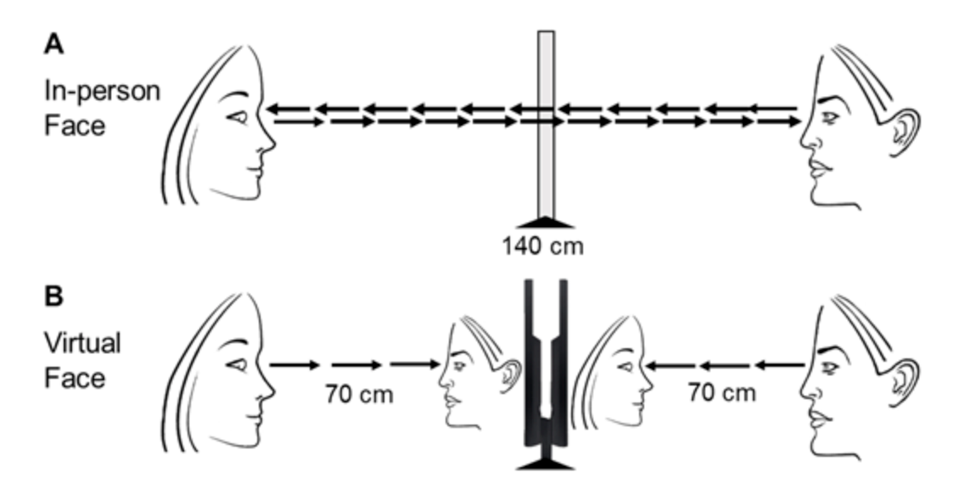
#### Key Findings: Face-to-Face vs. Virtual
* **Eye Contact.** People spent more time looking at real faces than those on screens.
* **Brain Activity.** In-person interactions showed increased cross-brain synchrony and higher signal strength, indicating richer social context and better facial expression processing.
Some content could not be imported from the original document. [View content ↗](https://www.youtube.com/embed/3Sk26hPG2jc?wmode=transparent&rel=0&feature=oembed)
#### Real-World Implications and The Future of Work
The controlled lab setting was more conducive to virtual interaction than what might happen in the real world. Subjects weren’t checking email, texting, or playing games. Kids and pets weren’t interrupting. Their cameras were always on, not typical for real virtual meeting. [Zoom data](https://blog.zoom.us/how-you-used-zoom-2022/) shows that 42% of participants in virtual meetings prefer to keep their cameras off. Separately, Stanford researchers identified “Zoom fatigue” as a real thing, caused by factors like excessive eye contact, cognitive load, the weirdness of watching yourself on the screen, and not being able to move around.
According to [Fortune](https://fortune.com/2023/10/16/office-return-rto-ceos-hybrid-remote-work-5-days/), CEOs are plotting to have everyone back in the office full time within a few years. Research showing that virtual interactions are less engaging than in person will bolster their case for a full return to the office.
Metaverse enthusiasts may find the Yale research encouraging. Some, like Meta, are working on technology to increase the realism of virtual interactions. Meta’s latest Quest Pro headset includes eye-tracking and facial expression detection. These movements and expressions can be shown on one’s avatar. At the moment, though, these avatars are improving but are still primitive and cartoonish. They are years away from replicating the richness of in-person meetings.
#### Make Your Meetings Better
Virtual meetings and Zoom calls aren’t going away. Some people will work from home, at least some of the time. Teams will continue to include members in different locations, even different countries. But, we should account for the fact that our brains are less engaged in a virtual interaction than face-to-face,
**Question the Need.** As discussed in my book *[Friction](https://www.neurosciencemarketing.com/blog/articles/strategy-business-books.htm)*, businesses globally suffer enormous productivity losses from unnecessary meetings. Before we focus on improving engagement, we should determine if a meeting is necessary and/or if the number of people who attend can be reduced.
**Use Virtual Tools Wisely.** Zoom calls are fine for brief updates and information sharing and other routine, transactional meetings. Other topics may have a higher emotional component – performance reviews, layoff announcements, team celebrations, etc. If at all possible, conduct meetings requiring emotional engagement or extensive collaboration in person.
**Stay Tuned in Virtual.** Sometimes, higher stakes meetings have to take place virtually even when you’d prefer them to be in person. When this happens, everyone should have their cameras on. Pay close attention to the participants’ expressions and body language. This will help you understand not just what they are thinking, but what they are **feeling**.
Some content could not be imported from the original document. [View content ↗](https://app.getresponse.com/site2/roger_67453/?u=32WN&webforms_id=B3djY&v=0)
##### *Related*
A recurring theme in quite a few of our neuromarketing posts is the apparent contest between the amygdala, a brain structure long thought to be the seat of emotions in the brain, and other brain structures thought to be responsible for higher cognitive functions like reasoning and problem solving. Now,…
Functional magnetic resonance imaging has been one of the tools of choice for neuroscientists investigating brain activity - its scan data can be processed into colorful brain images showing which areas of the brain are active at a given time. fMRI has had some drawbacks - equipment that is costly…
[](https://www.neurosciencemarketing.com/blog/articles/second-life-neuroscience.htm)
These days, people are spending a lot of time online, much of it in Web communities and social networks. Second Life is a virtual world in which users create avatars to represent themselves and interact with others. Entrepreneurs have started businesses there, ranging from stores and clubs to clothing design…, Your Brain on Zoom Calls: New Research, Roger Dooley, 01hhpvs0y73shtn7xe4ga6jn1a.