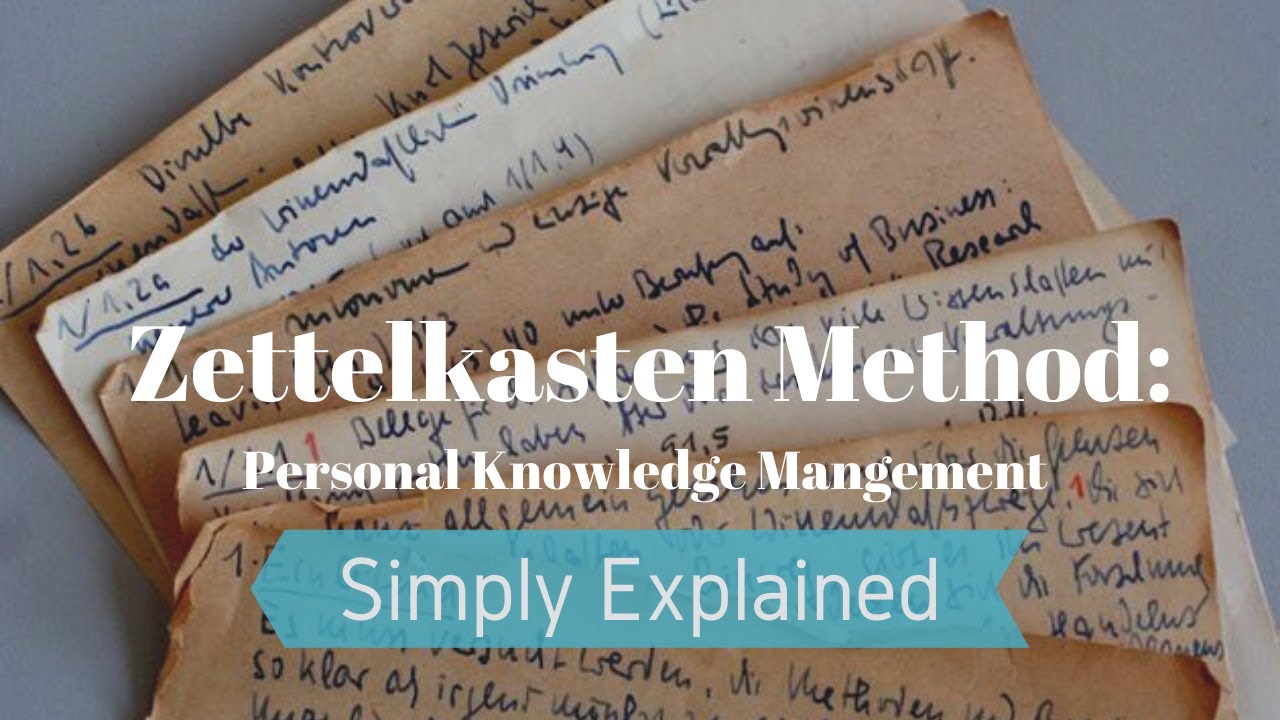
Zettelkasten Note-Taking Method: Simply Explained
## Metadata
- Author: [[YouTube]]
- Full Title: Zettelkasten Note-Taking Method: Simply Explained
- Category: #articles
- Document Note: ---
tags: [zettelkasten, knowledge-management, note-taking]
author: Shu
source: YouTube
reference: https://www.youtube.com/watch?v=rOSZOCoqOo8
date created: 2024-12-19 14:32
---
# 🏷️ Title: Zettelkasten Note-Taking Method: Simply Explained
## 🧰 Action Inbox
- [H1] Set up bibliographical and main note boxes — 01:15 #setup
- [H2] Practice writing literature notes in own words — 02:30 #practice
- [H3] Develop connection-finding questions for permanent notes — 04:45 #workflow
## 🧭 Table of Contents
- [📝 Summary](#-summary)
- [📖 Main Content](#-main-content)
- [🗒️ Notes](#️-notes)
- [📚 References](#-references)
- [🗣️ Paraphrase](#️-paraphrase)
- [📰 Newsletter](#-newsletter)
- [✅ Action Items](#-action-items)
- [🧪 Hypotheses](#-hypotheses)
- [📊 Methodology](#-methodology)
- [❓ Questions](#-questions)
- [🔮 Future Research](#-future-research)
- [💡 Implications](#-implications)
- [🧠 Learning Styles Assessment](#-learning-styles-assessment)
- [📊 Accessibility Assessment](#-accessibility-assessment)
- [🌍 DEIB Assessment](#-deib-assessment)
- [✅ Logical Validity](#-logical-validity)
- [🛡️ DARVO Analysis](#-darvo-analysis)
- [🎯 Conclusion](#-conclusion)
### 🔗 References
- [Zettelkasten Note-Taking Method: Simply Explained](https://www.youtube.com/watch?v=rOSZOCoqOo8)
- [Niklas Luhmann's Original Method](https://en.wikipedia.org/wiki/Niklas_Luhmann)
## 📝 Summary
- Zettelkasten is a German knowledge management method meaning "box of cards"
- Developed by sociologist Niklas Luhmann who published 58 books in 30 years
- Uses physical index cards in two boxes: bibliographical notes and main ideas
- Core process involves literature notes, bibliographical notes, permanent notes, and fleeting notes
- Bottom line: Creates a web of knowledge through meaningful connections rather than simple storage
## 📖 Main Content
The Zettelkasten method is a knowledge management system that emphasizes building connections between ideas rather than simply collecting information. German sociologist Niklas Luhmann developed this approach using physical index cards stored in boxes, enabling his extraordinary productivity of 58 books and hundreds of articles over 30 years.
The system consists of four types of notes: literature notes (brief summaries in your own words), bibliographical notes (reference details and content summaries), permanent notes (connected insights that build knowledge webs), and fleeting notes (temporary idea captures). The key innovation is focusing on retrievability through meaningful connections rather than categorization, asking "when would I want to rediscover this?" instead of "where does this belong?"
## 🗒️ Notes
#### ⏱️ [00:00](https://www.youtube.com/watch?v=rOSZOCoqOo8&t=0) — [H1] Introduction to Zettelkasten Method
- Key idea: Zettelkasten is an effective but underknown knowledge management system
- Evidence: "Zettelkasten method is one of the most effective knowledge management methods but it's not known by many people"
#### ⏱️ [00:30](https://www.youtube.com/watch?v=rOSZOCoqOo8&t=30) — [H1] Niklas Luhmann's Extraordinary Productivity
- Key idea: Luhmann's writing efficiency demonstrates the system's power
- Evidence: "In 30 years he published 58 books and hundreds of articles"
#### ⏱️ [01:05](https://www.youtube.com/watch?v=rOSZOCoqOo8&t=65) — [H2] Core Benefits of Zettelkasten
- Key idea: The system enables knowledge web building, memory retrieval, and efficient idea development
- Evidence: "It allowed him to build huge web of knowledge, retrieve the right memory when needed, find meaningful connections"
#### ⏱️ [01:15](https://www.youtube.com/watch?v=rOSZOCoqOo8&t=75) — [H2] Physical Setup Requirements
- Key idea: Simple materials enable the entire system
- Evidence: "All you need is small boxes, index cards and a pen"
#### ⏱️ [01:25](https://www.youtube.com/watch?v=rOSZOCoqOo8&t=85) — [H2] Two-Box System Structure
- Key idea: Luhmann separated bibliographical references from idea development
- Evidence: "Luhmann had two boxes one for bibliographical notes...and the main box where he collected and created new ideas"
#### ⏱️ [01:45](https://www.youtube.com/watch?v=rOSZOCoqOo8&t=105) — [H3] Literature Notes Process
- Key idea: Active note-taking while reading prevents passive consumption
- Evidence: "When you find an information you don't want to forget...write it down in your index card instead of highlighting"
#### ⏱️ [02:15](https://www.youtube.com/watch?v=rOSZOCoqOo8&t=135) — [H3] Writing in Own Words Requirement
- Key idea: Paraphrasing forces genuine understanding
- Evidence: "Writing in your own words may take a while, but it forces you to really understand what they mean"
#### ⏱️ [02:35](https://www.youtube.com/watch?v=rOSZOCoqOo8&t=155) — [H3] Bibliographical Notes Structure
- Key idea: Reference cards capture both citation and content summary
- Evidence: "Luhmann wrote down reference information on one side...and a brief note about content on the other side"
#### ⏱️ [02:55](https://www.youtube.com/watch?v=rOSZOCoqOo8&t=175) — [H1] Permanent Notes as Core Process
- Key idea: Permanent notes are the most critical step for knowledge building
- Evidence: "The third step probably the most important step is making permanent notes"
#### ⏱️ [03:20](https://www.youtube.com/watch?v=rOSZOCoqOo8&t=200) — [H2] Connection-Finding Over Collection
- Key idea: Value creation comes from relating new ideas to existing knowledge
- Evidence: "Your goal is not to collect as many notes as possible but to add new values to your existing ideas"
#### ⏱️ [03:45](https://www.youtube.com/watch?v=rOSZOCoqOo8&t=225) — [H2] Web of Knowledge Benefits
- Key idea: Dense connections improve both learning and memory retrieval
- Evidence: "The more web of knowledge you develop it's easier it becomes to learn and retrieve the information"
#### ⏱️ [04:20](https://www.youtube.com/watch?v=rOSZOCoqOo8&t=260) — [H3] Connection-Finding Questions
- Key idea: Systematic questions help discover meaningful relationships
- Evidence: "How does this idea fit into what I know? can this be explained by something else"
#### ⏱️ [04:45](https://www.youtube.com/watch?v=rOSZOCoqOo8&t=285) — [H2] Keywords for Retrieval Not Storage
- Key idea: Keyword strategy should focus on rediscovery circumstances
- Evidence: "Finding keyword is not about where to store a note but about how to retrieve it"
#### ⏱️ [05:20](https://www.youtube.com/watch?v=rOSZOCoqOo8&t=320) — [H3] Fleeting Notes for Temporary Capture
- Key idea: Quick capture prevents losing spontaneous ideas
- Evidence: "They are temporarily holders or your ideas and thoughts that pop into your mind like ideas you get while taking shower"
#### ⏱️ [06:15](https://www.youtube.com/watch?v=rOSZOCoqOo8&t=375) — [H1] Writing Process Integration
- Key idea: The system transforms writing from starting from scratch to reassembly
- Evidence: "You don't have to start from scratch when writing. All you have to do now is to reassemble your notes into a logical order"
## 📚 References
- [Zettelkasten Note-Taking Method: Simply Explained](https://www.youtube.com/watch?v=rOSZOCoqOo8)
- [Niklas Luhmann Biography](https://en.wikipedia.org/wiki/Niklas_Luhmann)
- [How to Take Smart Notes by Sönke Ahrens](https://takesmartnotes.com/)
## 🗣️ Paraphrase
- The Zettelkasten method transforms note-taking from passive information storage into active knowledge building through systematic connection-making between ideas
- Niklas Luhmann's extraordinary academic output of 58 books in 30 years demonstrates the practical power of organizing knowledge as an interconnected web rather than isolated facts
- The four-step process (literature notes, bibliographical notes, permanent notes, fleeting notes) creates a sustainable workflow that makes writing feel like reassembling existing insights rather than generating content from nothing
## 📰 Newsletter
**Transform Your Knowledge Management with the Zettelkasten Method**
Ever feel like you're reading constantly but struggling to connect ideas or remember key insights when you need them? The Zettelkasten method might be your game-changer. This German "box of cards" system helped sociologist Niklas Luhmann publish 58 books in 30 years by building a web of connected knowledge rather than just collecting isolated facts.
The beauty lies in its simplicity: write literature notes in your own words, create permanent notes that connect to existing ideas, and use keywords based on when you'd want to rediscover information (not where it belongs). Whether you use physical cards or digital tools, the key is transforming every piece of information into part of a growing knowledge network.
Ready to stop starting from scratch every time you write? Your future self will thank you for building these knowledge connections today.
Resources: [Zettelkasten Method](https://zettelkasten.de/), [Roam Research](https://roamresearch.com/), [Obsidian](https://obsidian.md/)
## ✅ Action Items
#### DevRel
- Education: Workshop curriculum on developer knowledge management systems
- Developer experience: Documentation templates using connection-based organization
- Developer marketing: Content strategy building knowledge webs across blog posts
- Community management: Implement permanent note system for tracking community insights
#### OSPO
- Policy & Governance: Connection-mapped policy documentation for easier retrieval
- Developer Support: Knowledge base using Zettelkasten principles for support teams
- Community Engagement: Relationship mapping between upstream projects and maintainers
- Strategic Alignment: Connect OKRs through web relationships rather than silos
#### Community
- Maintainers: Knowledge sharing systems for project continuity
- Contributors: Onboarding materials that connect concepts progressively
- Ecosystem: Cross-project insight sharing using permanent note methods
#### WordPress
- Documentation: Reorganize DevHub using connection-based rather than hierarchical structure
- Training: Lesson plans that build knowledge webs rather than isolated skills
- Community: Meetup organizer knowledge sharing system using Zettelkasten principles
#### The WPCC
- Programs: Fellowship knowledge transfer using permanent note systems
- Projects: Documentation sprints focused on connection-building between concepts
## 🧪 Hypotheses
- Organizations using connection-based knowledge management achieve higher knowledge retention than hierarchical filing systems
- Developers who practice Zettelkasten methods demonstrate improved code documentation and knowledge transfer
- Teams implementing permanent note workflows reduce time spent searching for previously learned information
- Knowledge workers using retrieval-focused keywords show better long-term idea development than category-based systems
### 📊 Methodology
- A/B testing teams using Zettelkasten vs. traditional note-taking over 6 months measuring idea connection frequency
- Survey developers before/after implementing permanent note workflows tracking documentation quality scores
- Time-tracking studies comparing information retrieval speed between connection-based and hierarchical knowledge systems
### ❓ Questions
- How can digital tools preserve the serendipitous discovery benefits of physical card browsing?
- What connection patterns emerge in successful Zettelkasten systems across different knowledge domains?
- How do team-based Zettelkasten implementations differ from individual practice in effectiveness?
### 🔮 Future Research
- AI-assisted connection discovery in large Zettelkasten databases
- Integration patterns between Zettelkasten and modern PKM tools like Roam and Obsidian
- Collaborative knowledge web building in distributed teams
### 💡 Implications
- Practice: Shifts daily note-taking from passive collection to active connection-building
- Education: Curriculum design should emphasize concept relationships over isolated skill development
- Documentation: Technical writing benefits from web-based rather than hierarchical organization
- Funding: Knowledge management tool investments should prioritize connection discovery over storage capacity
### 🧠 Learning Styles Assessment
Reading level estimate: 8th Grade (Flesch-Kincaid)
#### 👀 Visual learners
- Present: Clear step-by-step process description, box visualization
- Improve: Flow diagrams showing note relationships, card layout examples
#### 🔊 Aural learners
- Present: Video explanation with clear narration
- Improve: Podcast version, audio examples of connection-finding questions
#### 🗣️ Verbal learners
- Present: Strong definitions, clear analogies (web of knowledge, hooks for memory)
- Improve: More metaphors for abstract concepts, terminology glossary
#### 🧩 Kinesthetic learners
- Present: Hands-on card manipulation, physical setup instructions
- Improve: Practice exercises, step-by-step implementation checklist
#### 🧠 Logical learners
- Present: Clear sequential process, cause-and-effect relationships
- Improve: Decision trees for keyword selection, connection logic frameworks
#### 🧑🤝🧑 Social learners
- Present: Community examples, collaboration suggestions
- Improve: Group Zettelkasten exercises, peer review workflows
#### 🧘♀️ Solitary learners
- Present: Individual practice focus, personal knowledge building
- Improve: Reflection prompts, self-assessment rubrics
#### 🌿 Naturalistic learners
- Present: Organic knowledge growth analogies
- Improve: Ecosystem metaphors for knowledge networks
### 📊 Accessibility Assessment
#### Screen reader semantics
- Present: Clear heading hierarchy, descriptive video content
- Improve: Alt text for visual examples, transcription with timestamps
#### Keyboard navigation
- Present: Standard video controls
- Improve: Skip-to-section functionality, keyboard shortcuts
#### Contrast and readability
- Present: High contrast video text, clear audio
- Improve: Closed captions, transcript formatting
#### Text resizing and reflow
- Present: Responsive video player
- Improve: Scalable transcript text, adjustable playback speed
#### Media and captions
- Present: Audio explanation available
- Improve: Professional captions, downloadable transcript
#### Forms and interactions
- Present: Simple video interface
- Improve: Interactive examples, accessible practice tools
### 🌍 DEIB Assessment
#### Cultural breadth
- Present: Universal knowledge management principles
- Improve: Examples from diverse academic traditions, multilingual terminology
#### Inclusive language
- Present: Clear, accessible explanations
- Improve: Define German terms, avoid academic jargon
#### Neurodiversity support
- Present: Step-by-step structure, chunked content
- Improve: Multiple processing pathways, visual + textual + kinesthetic options
#### Representation
- Present: Focus on method rather than personal characteristics
- Improve: Diverse example domains beyond academic writing
#### Psychological safety
- Present: Non-judgmental approach to learning
- Improve: Normalize different implementation speeds, multiple valid approaches
### ✅ Logical Validity
#### Strong reasoning
- Deductive strength: Luhmann's productivity → method effectiveness (strong example)
- Inductive strength: Connection-making → better retrieval (well-supported)
- Causal reasoning: Active paraphrasing → deeper understanding (established pedagogy)
- Analogical strength: Knowledge as web vs. filing cabinet (effective metaphor)
#### Fallacies
- Appeal to authority: Relies heavily on L
- Document Tags: [[setup]] [[practice]] [[workflow]]
- Summary: Zettelkasten Note-Taking Method: Simply Explained
- URL: https://www.youtube.com/watch?v=rOSZOCoqOo8
hello my name is Shu. in this video I
want to talk about Zettelkasten method which is one of my favorite personal
knowledge management systems. Zettelkasten method is one of the most
effective knowledge management methods but it's not known by many people the
word Zettelkasten means box of cards in German.
this method was developed by Niklas Luhmann, a German sociologist he may not
be super famous but what makes him stand out from the crowd is not just the fact
he was an exceptional scholar but also
his writing efficiency. In 30 years he
published 58 books and hundreds of articles how did he manage to write so
much? It's thanks to his unique knowledge management system -- Zettelkasten Method.
It allowed him to build huge web of knowledge, retrieve the right memory
when needed, find meaningful connections among topics and develop his ideas
arguments and discussions efficiently the process of Zettelkasten is simple
all you need is small boxes, index cards
and a pen Luhmann had two boxes one for
bibliographical notes with the reference details and brief notes about
content of the literature and the main box where he collected and created new
ideas and the insights. The first step is taking
literature notes. When you are reading a book or article always have a pen and
index card with you and when you find an information you don't want to forget or
think you might use in your writing or thinking write it down in your index
card instead of highlighting or underlining. But you have to be careful
that it has to be brief to make it easy
to review later and you have to write it
in your own words this means no copy and pasting. Writing in your own words may take a
while, but it forces you to really understand what they mean. The second step is taking
bibliographical notes whenever you finish reading something Luhmann wrote
down reference information on one side of an index card and a brief note
about content on the other side then he kept cards in the bibliographical box
with the literature notes. The third step probably the most important step is
making permanent notes go through each
note you made in the previous step while
thinking about how they relate to what you are learning, your interest, thinking
or research. Your goal is not to collect as many notes as possible but to add new
values to your existing ideas argument and discussions. What's important here is
finding meaningful connections between why you just learned and why you already
know. By doing so you build a web of knowledge. The more web of knowledge
you develop it's easier it becomes to learn and retrieve the information from
your brain. This is because the more
information means more hooks we can use
to connect a new information to and more connected to information also means more
cues we can use to trigger the right memory to find such connections
efficiently ask yourself how does this idea fit into what I know? can this be
explained by something else. what does X mean for Y. how can I use this idea to
explain something else? additionally it's important to find keywords in your notes
to find connections among notes. But finding keyword is not about where to
store a note but about how to retrieve
it. When deciding a keyword
many people ask which keyword is most fitting or which category does this note
fall into? Rather you should ask yourself in which circumstances would I want to
stumble upon this note even if I forget about it
or when and how we are use this idea? Keywords should always be assigned with an eye
towards topic you're working on or interesting never by looking at a note
in isolation. After finding connections add your new permanent notes to the main box
by filling each one behind relevant
notes adding links to relevant notes and
indexing in the way you can easily discover later. An extra step you might
need is taking fleeting notes they are temporarily holders or your ideas and
thoughts that pop into your mind like ideas you get while taking shower or walk
always keep a notebook or piece of paper with you so you can write anytime. you
should review your fleeting notes within a few days before you forget what you
meant and you can develop them into permanent notes if necessary after
repeating those steps for a while you will have developed a huge web of
knowledge now whenever you need to find
a topic to write about, turn to your box
of cards and see the lines of the cards you developed. See what it's missing see
what questions arise you can then read more and take notes to develop your
ideas and arguments farther when you are done with this process you will already
have a wealth of information in your hands
this means you don't have to start from scratch when writing. All you have to do
now is to reassemble your notes into a logical order and translate them into
something coherent so this is a general
workflow of Zettelkasten.
in the next video I'll show you how to digitally implement this system using
Roam. thanks for watching and I'll see you in the next video bye!, Zettelkasten Note-Taking Method: Simply Explained, YouTube, 01ka7yr75f70qxsv5139warhsn.