assignment-tm-4233-0808
## Metadata
- Author:
- Full Title: assignment-tm-4233-0808
- Category: #articles
- Document Note: ---
tags:
- #trademark
- #wordpress
- #automattic
Author: United States Patent and Trademark Office (recording); Parties: WordPress Foundation (Licensor), Automattic Inc. (Licensee)
Source: USPTO Assignment Record (Trademark License)
Reference: https://assignments.uspto.gov/assignments/assignment-tm-4233-0808.pdf
date created: 2025-08-21 00:00
# Title: WordPress Foundation → Automattic Trademark License (June 2010)
## Table of Contents:
- [📝 Summary](#-summary)
- [📖 Main Content](#-main-content)
- [🗒️ Notes](#️-notes)
- [📖 References](#-references)
- [🗣️ Paraphrase](#-paraphrase)
- [📰 Newsletter](#-newsletter)
- [✅ Action Items](#-action-items)
- [🧪 Hypotheses](#-hypotheses)
- [📊 Methodology](#-methodology)
- [❓ Questions](#-questions)
- [🔮 Future Research](#-future-research)
- [💡 Implications](#-implications)
- [🧠 Learning Styles Assessment](#-learning-styles-assessment)
- [📊 Accessibility Assessment](#-accessibility-assessment)
- [🌍 DEIB (Diversity, Equity, Inclusion, and Belonging) Assessment](#-deib-diversity-equity-inclusion-and-belonging-assessment)
- [✅ Logical validity](#-logical-validity)
- [🔍 DARVO Analysis Prompt](#-darvo-analysis-prompt)
- [🔍 SEO Evaluation](#-seo-evaluation)
- [🎯 Conclusion](#-conclusion)
### References:
- USPTO Assignment PDF: https://assignments.uspto.gov/assignments/assignment-tm-4233-0808.pdf
## 📝 Summary:
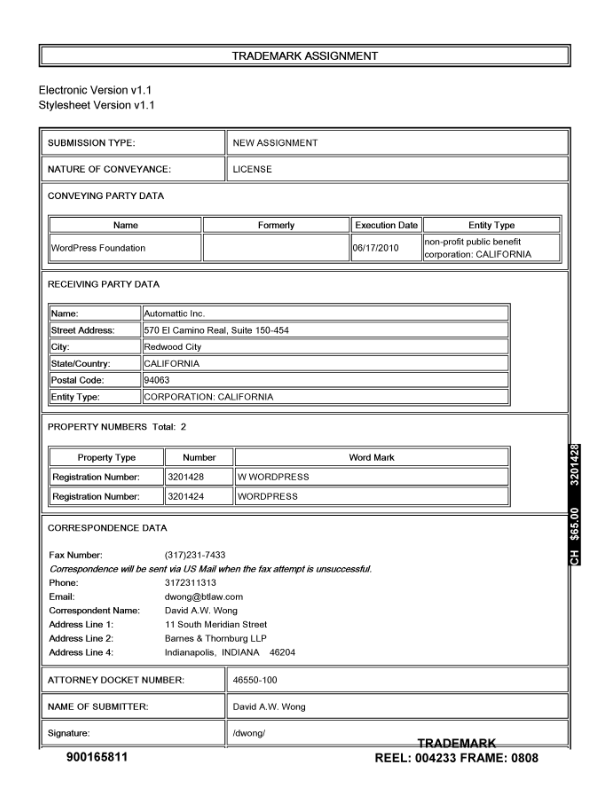
This USPTO filing records a June 7, 2010 trademark license from the WordPress Foundation (a California nonprofit public benefit corporation) to Automattic Inc. (a Delaware corporation). The license is described as exclusive, fully paid, royalty-free, perpetual, irrevocable, worldwide, and sublicensable. It covers specific WordPress-related trademarks identified in Exhibit/Schedule A, plus related names, marks, designs, domain names, and associated goodwill, for use in connection with hosting blogs and websites that use WordPress, support for Automattic-operated sites (e.g., wordpress.com and wordpress.tv and their subdomains), and substantially similar uses. The license is expressly subject to a separate “Trademark Donation, License and Security Agreement” effective the same day. The Foundation also agrees to cooperate in executing papers to record Automattic’s rights with government offices.
Notable points:
- Scope is broad but tied to Automattic’s sites and WordPress hosting/support context.
- The license is exclusive yet constrained by the governing master agreement.
- Record indicates two attachments/pages and signatures, with CEO title indicated.
## 📖 Main Content:
The document is a formal, recorded notice of a trademark license rather than a marketing or policy explainer. Key components:
- Parties and addresses: WordPress Foundation (San Francisco) as Licensor; Automattic (Redwood City) as Licensee.
- Effective date: June 7, 2010. Recording date appears June 29, 2010.
- Grant: Exclusive, fully paid, royalty-free, perpetual, irrevocable, worldwide, sublicensable license.
- Subject matter: Trademarks listed in Schedule/Exhibit A and “related or similar names, marks, designs, domain names, and other rights,” together with registrations/applications and goodwill.
- Field/purpose: “hosting of blogs and web sites that utilize any version or component of the WordPress open source publishing platform” and support for Automattic Sites (wordpress.com, wordpress.tv, subdomains), plus substantially similar uses.
- Conditions: License is “subject in all respects” to a Trademark Donation, License and Security Agreement (same effective date).
- Recordation cooperation: Licensor will execute papers to support recordation and proof as needed.
Contextual understanding:
- This aligns with the 2010 transfer of WordPress-related trademarks into the WordPress Foundation for stewardship while ensuring Automattic can operate WordPress.com and associated services using the marks.
- “Exclusive” in the specified context suggests Automattic holds unique rights for Automattic Sites use-cases, while the Foundation retains control via the master agreement for broader community protection.
### 🗒️ Notes
- Parties
- Licensor: WordPress Foundation (nonprofit)
- Licensee: Automattic Inc. (for-profit)
- Dates
- Effective license date: June 7, 2010
- USPTO record date on form: June 29, 2010
- License attributes
- Exclusive
- Fully paid and royalty-free
- Perpetual and irrevocable
- Worldwide
- Sublicensable
- Covered assets
- Trademarks in Schedule/Exhibit A
- Related/similar names, designs, domain names
- Associated registrations/applications and goodwill
- Field of use
- Hosting blogs/websites using WordPress
- Support and similar uses for Automattic Sites (wordpress.com, wordpress.tv, subdomains)
- Conditions and dependencies
- Subject to “Trademark Donation, License and Security Agreement” (same date)
- Foundation cooperation on documentation and recordation
- Operational implications
- Automattic can use and sublicense marks within Automattic Sites ecosystem
- Foundation preserves overarching governance via master agreement
- Signatures
- CEO title indicated on the signature block
## 📖 References:
- USPTO Assignment PDF (official record): https://assignments.uspto.gov/assignments/assignment-tm-4233-0808.pdf
## 🗣️ Paraphrase:
1) Original idea: The Foundation grants Automattic an exclusive, fully-paid, royalty-free, perpetual, irrevocable, worldwide, sublicensable license to use the identified WordPress-related trademarks and associated rights for Automattic Sites hosting/support contexts.
Paraphrase: Effective June 7, 2010, the WordPress Foundation gives Automattic a unique, global permission—paid in full and without ongoing royalties—to use and sublicense the WordPress trademarks (as listed in the exhibit) and related brand elements. This permission lasts indefinitely and can’t be revoked, and it specifically covers Automattic’s operation and support of WordPress-powered hosting on platforms such as wordpress.com and wordpress.tv.
2) Original idea: The license is subject to a Trademark Donation, License and Security Agreement, and the Foundation will assist with paperwork to record rights.
Paraphrase: The granted rights are governed by a separate, overarching contract executed the same day, which sets the controlling terms. The Foundation also agrees to sign necessary documents and take reasonable steps so Automattic’s rights can be properly recorded with relevant authorities.
## 📰 Newsletter:
Title: WordPress, Trademarks, and the Open Web: A 2010 Paper Trail That Still Matters
Hey friends! Big archival gem this week: a 2010 USPTO filing shows the WordPress Foundation licensing core WordPress trademarks to Automattic—exclusively, worldwide, and royalty-free—for operating Automattic’s platforms like wordpress.com and wordpress.tv. Why care in 2025? Because trademark stewardship underpins trust. Clarity about who can use “WordPress” in which contexts helps protect contributors, users, and the brand.
Meanwhile in dev land: if you’re leveling up your web stack, revisit the fundamentals—PHP 8.x performance tips, modern JS tooling, and accessibility-first CSS patterns. Community highlights include new contributor sprints and funding discussions across the WordPress and broader FOSS ecosystem. Plugin corner: keep an eye on security and governance docs; brand usage compliance is part of running a professional site.
Recommended reads:
- WordPress trademark policy background via the WordPress Foundation
- Practical brand-compliance checklists for plugin authors
Stay curious, ship responsibly, and remember: open source thrives when our governance is as strong as our code.
## ✅ Action Items:
Prompt template aligning articles with your DevRel, open-source advocacy, and OSPO ambitions:
- Mission alignment
- How does this article illuminate governance models (e.g., trademark licensing, IP stewardship) that impact open-source sustainability within WordPress?
- Which aspects support transparent contributor onboarding and brand-safe community growth?
- Contributor engagement
- What practical guidance can I extract to help new contributors understand brand use, code of conduct, and project boundaries?
- Where can I design trainings or workshops (PHP/JS/Git/GitHub) that tie technical skills to policy literacy (e.g., trademark usage rules)?
- OSPO perspective
- What lessons apply to an OSPO’s policy stack (trademark policy, CLA/DCO, security response, funding)?
- Which metrics could an OSPO track to ensure responsible brand use and ecosystem health?
- Education and equity
- How can I translate legal/governance insights into inclusive, accessible learning materials for diverse learners?
- Which community mechanisms foster psychological safety while enforcing brand guidelines?
- Sustainability and funding
- Does the article suggest models for long-term project viability (e.g., separation of nonprofit stewardship vs. commercial operations)?
- How can these models inform advocacy for sustainable funding in the WordPress ecosystem?
- On-stage/off-stage integration
- Draft talk/workshop outlines connecting WordPress trademarks, open-source licensing, and day-to-day developer workflows.
- Create resources (slides, checklists, office hours) to help agencies and plugin authors comply with trademark policies.
## 🧪 Hypotheses:
- H1: Clear, public trademark governance increases legitimate ecosystem adoption while reducing brand misuse incidents.
- H2: Separating nonprofit trademark stewardship from commercial service delivery balances community protection with market agility.
- H3: Contributor onboarding that includes brand policy education decreases support burden and enforcement actions.
- H4: Sublicensing frameworks for hosted services improve partner compliance without slowing down product velocity.
### 📊 Methodology:
- Data sources: Public trademark records, Foundation policy pages, incident reports of misuse, GitHub/org onboarding docs, community forum moderation logs.
- Research designs:
- Comparative case study: WordPress vs. other FOSS projects (e.g., Mozilla, Linux Foundation projects) on trademark outcomes.
- Interrupted time series: Brand misuse reports before/after policy clarifications.
- Survey research: Contributors’ understanding of trademark rules vs. compliance behavior.
- Analysis techniques: Descriptive stats, logistic regression for misuse predictors, qualitative coding of enforcement narratives, difference-in-differences across ecosystems.
### ❓ Questions:
- What exact marks appear in Schedule/Exhibit A, and how have they evolved?
- How does the master “Trademark Donation, License and Security Agreement” constrain or define “exclusive” for Automattic Sites?
- What sublicensing processes/checks exist for partners building on wordpress.com?
- How are community education and enforcement coordinated between the Foundation and Automattic?
### 🔮 Future Research:
- Mapping governance impact: trademark policy clarity vs. contributor growth and brand trust.
- Optimal boundaries for “exclusive” licenses in mixed nonprofit/commercial ecosystems.
- Playbooks for community education on brand use integrated into dev tooling.
### 💡 Implications:
- Strong governance can safeguard brand integrity, improving user trust and reducing confusion.
- Clear division of roles (nonprofit stewardship vs. commercial operations) can stabilize funding while preserving community ethos.
- Education-first enforcement may yield better compliance than punitive-first models.
### 🧠 Learning Styles Assessment:
- Readability: Legal/administrative; college-level reading due to formal legal language.
- Visual (Present): Minimal; scanned form structure. Improve: Add diagrams explaining party relationships, scope, and field-of-use.
- Aural (Present): None. Improve: Provide an audio summary of key clauses.
- Verbal (Present): Dense legal prose. Improve: Add plain-language summaries and glossaries.
- Physical (Present): None. Improve: Interactive checklists for brand-use scenarios.
- Logical (Present): Clear conditional structure (“subject to agreement”). Improve: Flowcharts for decision-making (can I use the mark?).
- Social (Present): None. Improve: Link to community discussions/office hours on trademark usage.
- Solitary (Present): Possible via self-study. Improve: Reflection prompts and quizzes.
- Naturalistic (Present): Not applicable. Improve: N/A.
### 📊 Accessibility Assessment:
- Screen reader: Likely a scanned PDF; text extraction partly available but images present. Improve: Provide tagged, semantic PDF with OCR-verified text and reading order.
- Keyboard navigation: PDF may not be fully navigable. Improve: Ensure bookmarks, headings, and logical order.
- Contrast/readability: Dependent on scan; could be inconsistent. Improve: High-contrast, selectable text version.
- Text resizing: Scanned images can degrade. Improve: Reflowable HTML version and accessible PDF/A.
### 🌍 DEIB (Diversity, Equity, Inclusion, and Belonging) Assessment:
- Cultural relevance: Neutral legal record. Improve: Pair with community-facing guidance accessible to non-lawyers and non-native speakers.
- Inclusive language: Legal formalities; neutral. Improve: Provide plain-language translations and define terms.
- Neurodiversity: Dense blocks hinder comprehension. Improve: Use headings, bullets, and summaries.
- Representation: Not applicable in legal filing. Improve: Add inclusive examples in accompanying guidance.
- Psychological safety: Neutral. Improve: Offer clear, non-punitive educational resources and transparent enforcement policies.
### ✅ Logical validity:
- Nature: This is a legal instrument, not an argumentative essay.
- Positive reasoning elements:
- Logical flow: Parties → grant → scope → conditions → cooperation obligations. This structure clarifies obligations and boundaries.
- Causal reasoning: “Subject to” clause ties license validity to the master agreement, preventing contradictions.
- Appeal to facts: Specific dates, parties, sites, and fields of use add precision.
- Suggestions:
- Include a public-facing summary cross-referencing the master agreement to enhance clarity.
- Provide explicit definitions of “exclusive” relative to other Foundation uses.
No apparent logical fallacies; the document does not present persuasive arguments but records terms.
🔍 DARVO Analysis Prompt
- Deny: Not present. No allegations or denials; purely transactional language.
- Attack: Not present. No adversarial framing or character judgments.
- Reverse Victim and Offender: Not present. The filing does not portray conflicts or victimhood.
Tone: Formal, neutral, administrative. No emotional cues or rhetorical tactics.
### 🔍 SEO Evaluation:
- Keywords: As a legal PDF, not optimized. Add keywords like “WordPress trademark license,” “Automattic license 2010,” “WordPress Foundation trademarks.”
- Meta description: Not applicable to the PDF as-is. If hosted on a web page, add a 150–160 character summary including primary keyword.
- Title tag: Ensure a clear HTML page title if republished: “WordPress Foundation Trademark License to Automattic (2010).”
- Headers: Use H1/H2/H3 in an accompanying article.
- Content length: Create a 1,000–1,500-word explainer post around the PDF.
- Links: Include authoritative links to the Foundation’s trademark policy and Automattic brand guidelines.
- URL: Use concise, keyword-rich slug.
- Images: If adding exhibits, include alt text and optimized filenames.
- Mobile optimization: Publish a responsive HTML summary page.
- Engagement: Add FAQs, timelines, and CTAs to related resources.
- Schema: Use Article schema; consider LegalService or CreativeWork where appropriate.
- Social: Add Open Graph/Twitter Card tags for previews.
## 🎯 Conclusion:
The 2010 WordPress Foundation-to-Automattic trademark license formalizes Automattic’s exclusive, royalty-free, perpetual, worldwide, and sublicensable rights to use specific WordPress marks in connection with Automattic-operated platforms like wordpress.com and wordpress.tv. The license is governed by a master agreement that preserves the Foundation’s stewardship over WordPress trademarks. For open-source governance, it exemplifies how nonprofit custodianship can coexist with commercial operations, reinforcing brand integrity while enabling scale. This model offers practical lessons for OSPOs, DevRel education, and community policy design aimed at sustaining an inclusive and trustworthy open-source ecosystem.
- URL: https://read.readwise.io/read/01ja6ytexbfcrdcyb53gc5g24z
Full text of this document omitted because this document is a PDF
[Download original file →](https://readwise.io/reader/document_raw_content/226394658), assignment-tm-4233-0808, , 01ja6ytexbfcrdcyb53gc5g24z.